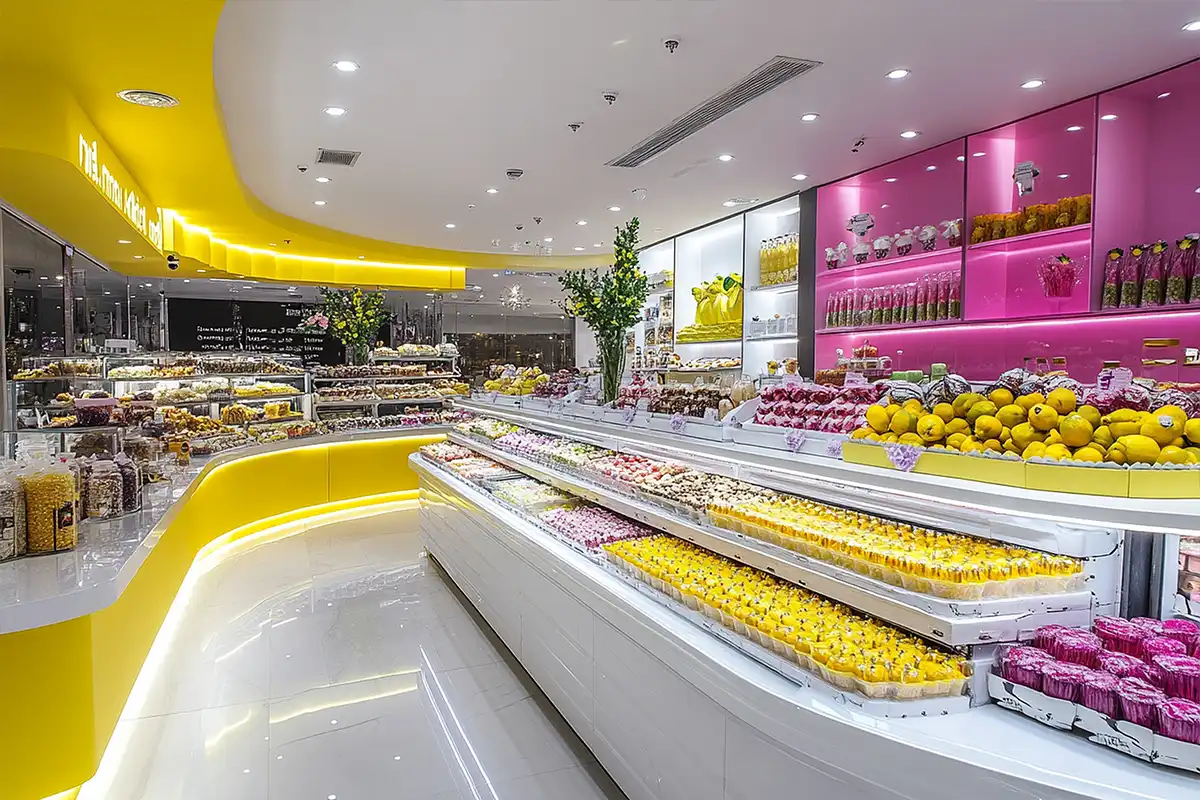
Supermarket & Hypermarket Lighting Design
Retail lighting inside supermarkets and hypermarkets requires structured planning, system selection, and precise execution across aisles, shelves, cold storage, and billing zones. Supermarket & Hypermarket Lighting Design involves layout planning, fixture selection, power distribution, and on-site installation under a complete EPC model.


What This Service Includes
Supermarket & Hypermarket Lighting Design covers the entire lifecycle of retail lighting projects. It includes zoning of store areas, lux level calculation, fixture mapping, control system planning, procurement, and on-site installation. Execution also involves alignment between design drawings and real-site constraints, ensuring the lighting behaves as intended once installed.
VS Wilson operates from UAE and executes projects across the Middle East, USA, and Europe through on-site deployment. This includes engineering design, material procurement, installation, and final commissioning. The service functions as a complete project delivery system rather than isolated design or supply work.


What This Service Includes
Layout-driven lighting planning for retail floor efficiency
Design considers aisle flow, shelf depth, and visibility challenges
Fixture selection based on product display requirements
Different zones require different beam angles and intensity control
Procurement aligned with project scale and specifications
Material sourcing is coordinated with design intent and installation conditions
On-site execution with installation and testing workflows
Teams handle wiring, mounting, alignment, and final system calibration
Supermarket & Hypermarket Lighting Design covers the entire lifecycle of retail lighting projects. It includes zoning of store areas, lux level calculation, fixture mapping, control system planning, procurement, and on-site installation. Execution also involves alignment between design drawings and real-site constraints, ensuring the lighting behaves as intended once installed.
Supermarket Lighting Design & Installation
This variation reflects smaller-format retail environments where product density is high and aisle spacing is tighter. Users searching for this still require full Supermarket & Hypermarket Lighting Design execution, but focused on compact layouts and high turnover product zones.
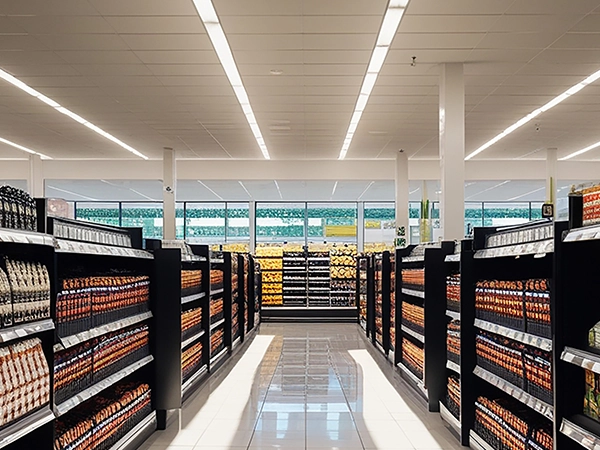
In actual projects, supermarket lighting needs careful balancing. Over-lighting increases energy cost, while under-lighting reduces product visibility. Installation must align fixtures precisely above shelving lines to avoid shadow zones. The execution includes ceiling-mounted linear systems, targeted spot lighting for promotional racks, and integrated refrigeration lighting.
Grocery Store Lighting Design
Grocery store lighting design is often searched for neighborhood-scale stores, but the requirement still falls under the same service. The difference lies in scale, ceiling height, and product arrangement.
From an execution point of view, grocery stores often face uneven lighting due to mixed fixture types installed over time. A structured design replaces this with consistent lighting zones. Installation also needs to consider existing wiring limitations and operational continuity, as many grocery stores cannot shut down completely during upgrades.
Hypermarket Lighting Solutions
Hypermarket lighting solutions represent large-scale retail environments with complex zoning. This keyword variation still maps to the same core service but with higher execution complexity.
Hypermarkets require layered lighting systems. General lighting covers large floor areas, while focused lighting highlights fresh produce, meat sections, and promotional displays. Installation involves coordination across large ceiling grids, ensuring uniform distribution without dark patches. Power load planning and maintenance accessibility become critical factors during execution.
Types of Lighting Solutions Offered
Aisle Linear Lighting
Used for continuous illumination across product rows, ensuring uniform visibility across shelves
Shelf & Display Lighting
Focused lighting installed within or above shelves to highlight product packaging and details
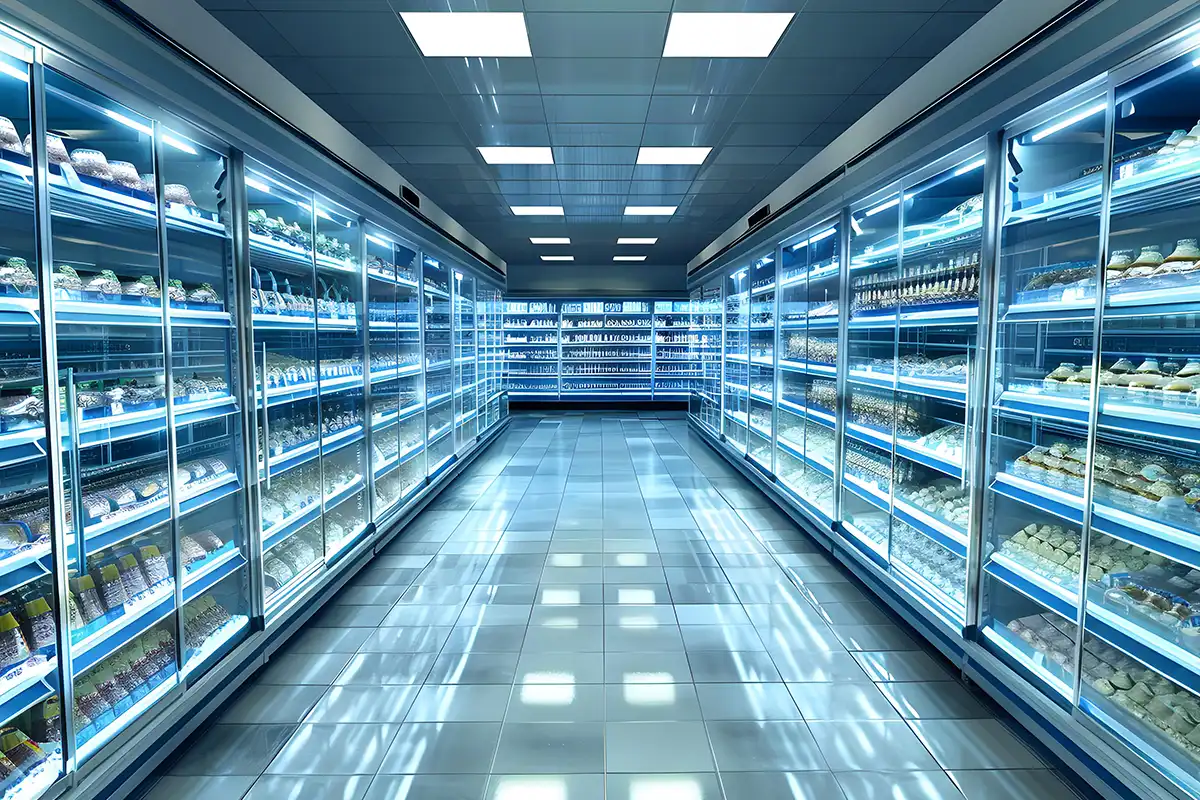
Refrigeration Case Lighting
Integrated lighting inside cold storage units to maintain visibility without heat impact
Checkout Counter Lighting
Balanced lighting for billing zones to avoid glare and improve transaction visibility
Accent Lighting for Promotions
Used for highlighting offers, end caps, and seasonal displays
Real-World Applications & Use Cases
In operational retail environments, lighting directly impacts product perception. Fresh produce sections often require higher color rendering to make fruits and vegetables appear natural. Packaged goods rely on uniform lighting to avoid shadow distortion.
In large hypermarkets, navigation becomes a challenge. Lighting is used to guide movement by differentiating zones. From an execution point of view, this involves varying intensity and beam spread across departments.
Another common situation arises in retrofit projects. Existing stores often suffer from uneven lighting due to incremental upgrades. A full redesign aligns all lighting systems into a cohesive layout, improving both visibility and operational efficiency.
When This Service Becomes Necessary
This service becomes necessary when retail spaces face inconsistent lighting, high energy consumption, or poor product visibility. It is also required during new store development where lighting must be integrated with architectural planning.
In many projects, lighting issues are noticed after store operation begins. Dark zones, glare, or uneven brightness lead to customer discomfort. Addressing these problems later becomes more complex without a structured design and execution plan.
Environments & Project Conditions This Service Fits
This service is suitable for supermarkets, grocery stores, hypermarkets, and retail chains with varied store sizes. It applies to both new construction and renovation projects.
From an execution perspective, ceiling height, shelving layout, and electrical infrastructure define how the lighting system is implemented. Projects in older buildings often require redesign of wiring routes, while new developments allow integration from the planning stage.
Project Execution Process
Supermarket & Hypermarket Lighting Design follows a structured EPC workflow. It begins with site analysis and layout mapping, followed by lighting calculations and fixture selection. Procurement is aligned with approved specifications to avoid mismatch during installation.
Execution includes installation of fixtures, wiring, alignment, and testing. In real projects, adjustments are often required on-site due to structural variations. Final commissioning ensures that lighting levels, distribution, and controls function as intended across all zones.
Technical & Safety Considerations
Retail lighting systems must handle long operational hours without performance drop. Heat management becomes important, especially near refrigeration units. Improper fixture selection can lead to overheating or reduced lifespan.
Electrical safety is another factor. Load distribution must be planned to avoid circuit overload. Emergency lighting integration is also required for compliance in commercial spaces.
Common Problems & Risks in Lighting Installation
One common issue is misalignment between design and installation. Fixtures placed incorrectly can create shadows or glare. Another problem arises when different contractors handle design and execution separately, leading to coordination gaps.
Low-cost installations often skip proper planning, resulting in higher maintenance and energy costs. In large retail environments, fixing these issues later becomes expensive and operationally disruptive.
How to Choose the Right Lighting Setup
Choosing the right setup involves evaluating store size, product categories, and operational hours. A supermarket requires different lighting compared to a hypermarket due to scale and layout complexity.
From a decision standpoint, buyers should consider long-term operational cost, maintenance access, and consistency of lighting across zones. Selecting fixtures without proper layout planning often leads to uneven performance.
Pricing Factors
Pricing depends on store size, ceiling height, fixture types, and installation complexity. Supermarkets with compact layouts require fewer fixtures but more precision, while hypermarkets involve large-scale installations.
Another factor is whether the project is new or retrofit. Existing infrastructure may require additional work, increasing cost. Low-cost setups often lead to higher long-term expenses due to inefficiency and maintenance issues.
Why Choose This Service
This service ensures that lighting design and execution are aligned from the beginning. It reduces coordination issues between different vendors and provides a single point of responsibility.
To understand execution capability and project handling approach, visit our About Us page.
Projects are handled with full lifecycle responsibility, ensuring that design intent is maintained during installation and final delivery.
Service Coverage
VS Wilson operates from UAE and executes projects across Dubai, Abu Dhabi, the Middle East, USA, and Europe. Teams are deployed on-site based on project requirements.
International projects are handled through planned deployment, ensuring consistency in execution without relying on third-party coordination.
Common Buyer Concerns Before Hiring
Buyers often worry about cost overruns and execution delays. In many cases, unclear scope leads to unexpected expenses during installation.
Another concern is performance mismatch. Lighting that looks good in design may not perform well on-site if execution is not aligned. Choosing a single EPC partner reduces these risks.
FAQs
1. What is supermarket & hypermarket lighting design?
It is a complete service that includes planning, fixture selection, procurement, and installation of lighting systems across retail environments. It ensures proper illumination for aisles, shelves, and display areas while maintaining energy efficiency and operational reliability.
2. Do you handle both design and installation?
Yes, the service follows an EPC model where design, procurement, and installation are handled as one integrated workflow. This avoids coordination gaps and ensures the final outcome matches the design intent.
3. Can you execute projects outside UAE?
Yes, projects are executed across the Middle East, USA, and Europe through on-site deployment. Teams travel based on project requirements and handle complete installation and delivery.
4. How long does a supermarket lighting project take?
Timeline depends on store size, complexity, and whether it is a new project or retrofit. Smaller stores can be completed faster, while hypermarkets require phased execution.
5. What lighting systems are used in supermarkets?
Systems include linear aisle lighting, shelf lighting, refrigeration lighting, and accent lighting. Selection depends on product type and store layout.
6. Is LED lighting mandatory for retail stores?
LED is widely used due to energy efficiency and long lifespan. However, the selection depends on project requirements and operational conditions.
Discuss Your Project
Lighting in retail environments depends heavily on layout, product type, and operational patterns. A structured discussion helps identify the right approach before execution begins.
Projects across UAE, Middle East, USA, and Europe are handled through on-site planning and deployment. You can discuss layout challenges, execution timelines, and system selection to align the project from the start.
Start a project discussion through the Contact page.
Image Gallery
Related Services