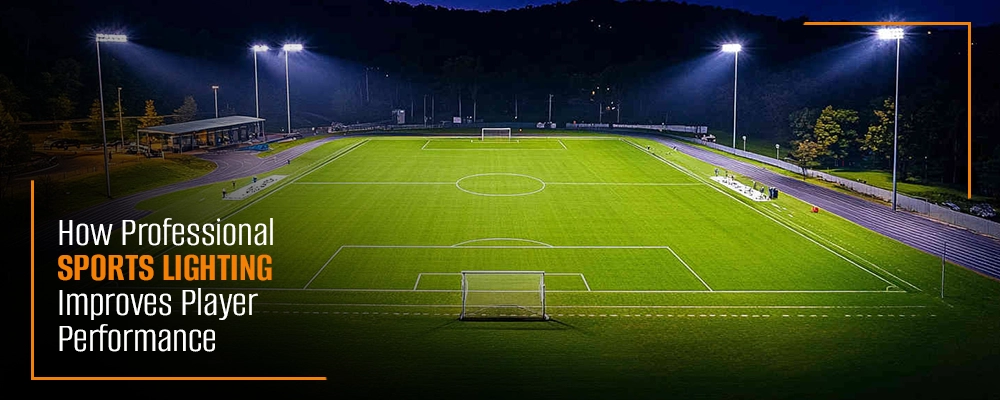
How Professional Sports Lighting Improves Player Performance
Across modern sports infrastructure—whether in professional stadiums, training academies, or multi-use recreational complexes—lighting has shifted from a utility component to a performance-critical system.
This shift is not accidental. As game speeds increase, broadcast requirements tighten, and athlete conditioning becomes more data-driven, lighting is now evaluated with the same rigor as turf systems, structural design, and environmental controls.
In procurement discussions, a recurring pattern emerges: lighting is often assessed late in the project lifecycle, yet it directly influences visibility, reaction time, fatigue, and even injury risk. This mismatch between importance and evaluation timing is where many performance gaps originate.
Manufacturers operating at scale, including export-oriented suppliers like VS Willson, increasingly approach sports lighting not as fixtures—but as engineered optical systems designed to support human performance under variable environmental conditions.
In practical terms, sports lighting is not just about brightness—it is about controlled light distribution, visual comfort, and consistency over time.
Technical Specifications & Key Features
Key Performance Parameters That Influence Player Performance
When evaluating sports lighting, several technical metrics directly correlate with how players perceive the field:
1. Illuminance (Lux Levels)
- Determines how clearly players can see the playing surface
- Professional fields often require:
- Training: 200–500 lux
- Competitive play: 500–1000+ lux
- Broadcast-grade: 1000–2000+ lux
2. Uniformity Ratio
- Ratio of minimum to average illuminance
- Poor uniformity leads to “dark patches” that disrupt depth perception
3. Glare Rating (GR or UGR)
- Excessive glare affects reaction time and ball tracking
- Controlled optics are essential in high-speed sports like football or tennis
4. Color Rendering Index (CRI)
- Higher CRI (>70–90) improves color differentiation
- Important for both players and referees
5. Correlated Color Temperature (CCT)
- Typically ranges between 4000K–5700K
- Neutral white enhances visual clarity without causing eye strain
Observation from Field Installations
In many retrofit projects, performance issues are not due to insufficient brightness—but uneven distribution and poor glare management. This is where engineered optics outperform generic high-output fixtures.
Materials & Production Methodology
The manufacturing of sports lighting systems involves a layered approach combining structural durability and optical precision.
Core Material Components
- Housing: Die-cast aluminum
- High thermal conductivity
- Corrosion resistance for outdoor environments
- Optical Lenses:
- Polycarbonate or tempered glass
- UV-stabilized for long-term clarity
- Heat Dissipation Systems:
- Integrated heat sinks
- Thermal interface materials (TIMs)
- Driver Units:
- Industrial-grade constant current drivers
- Surge protection integrated
Manufacturing Considerations
Production tolerances in sports lighting are tighter than in standard industrial lighting:
- Optical alignment tolerance impacts beam accuracy
- Heat management directly affects lumen maintenance
- Sealing (IP65/IP66/IP67) determines environmental resilience
Manufacturers supplying across regions such as the USA, Europe, and the Middle East often design for extreme climatic variations—ranging from desert heat to high humidity coastal conditions.
Performance & Durability Insights
How Lighting Directly Affects Player Performance
From an operational standpoint, lighting influences:
1. Reaction Time
Consistent illumination reduces visual adaptation delays.
2. Depth Perception
Uniform lighting ensures players can accurately judge ball trajectory.
3. Visual Fatigue
Lower glare and balanced CCT reduce eye strain over long matches.
4. Peripheral Awareness
Even light distribution improves awareness beyond the central field of view.
Durability Factors That Sustain Performance
Over time, lighting degradation can silently impact gameplay quality.
Key durability indicators include:
- Lumen Maintenance (L70/L80):
Indicates how long brightness remains within acceptable levels - Thermal Stability:
Overheating reduces both lifespan and light consistency - Ingress Protection:
Dust and moisture ingress affect optics and electronics - Vibration Resistance:
Important for high-mast installations
A common procurement oversight is evaluating initial performance without considering degradation curves over 3–5 years.
Applications & Use Environments
Sports lighting systems are deployed across varied environments, each with unique constraints:
Outdoor Applications
- Football and cricket stadiums
- Athletics tracks
- Tennis courts
- Multi-sport complexes
Environmental challenges include:
- Wind loads on high masts
- Dust accumulation
- Temperature fluctuations
Indoor Applications
- Basketball courts
- Badminton halls
- Gymnasiums
Here, glare control and ceiling height constraints play a more critical role.
Training vs Competitive Installations
Training facilities often prioritize:
- Energy efficiency
- Moderate lux levels
Professional venues require:
- Broadcast compatibility
- Higher uniformity and redundancy
Variants / Type Comparison (Neutral)
LED vs Metal Halide Sports Lighting
Parameter |
LED Sports Lighting |
Metal Halide Lighting |
|
Energy Efficiency |
High |
Moderate |
|
Warm-up Time |
Instant |
Delayed |
|
Maintenance |
Low |
High |
|
Lifespan |
50,000+ hours |
10,000–15,000 hours |
|
Light Control |
Precise optics |
Diffused |
|
Flicker |
Minimal |
Noticeable |
Insight:
While LED systems dominate new installations, retrofits still need careful recalibration. Simply replacing fixtures without adjusting beam angles often leads to suboptimal results.
Buyer Evaluation Checklist
For procurement teams evaluating sports lighting systems:
Technical Evaluation
- Required lux levels based on application
- Uniformity ratio compliance
- Glare rating suitability
- Beam angle customization
Material & Build Quality
- Housing material and coating
- Lens durability (UV resistance)
- Thermal management design
Performance Longevity
- Lumen maintenance rating
- Driver reliability
- Surge protection
Installation & Integration
- Mounting compatibility
- Mast height alignment
- Control systems (dimming, automation)
Supplier Capability
- Manufacturing scale
- Export experience
- Quality control processes
Early-stage evaluation across these parameters reduces long-term operational risk.
Frequently Asked Questions
1. How does sports lighting affect athlete performance?
Sports lighting impacts visibility, reaction time, and depth perception. Uniform, glare-free lighting helps athletes track movement accurately and reduces visual fatigue, improving overall performance consistency.
2. What is the ideal lux level for sports fields?
Lux requirements vary by use:
- Training: 200–500 lux
- Competitive play: 500–1000 lux
- Broadcast-level events: 1000–2000+ lux
The correct level depends on sport type and viewing requirements.
3. Why is uniform lighting important in sports?
Uniform lighting eliminates dark zones and ensures consistent visibility across the field, allowing players to maintain spatial awareness and accurate movement judgment.
4. What are the advantages of LED sports lighting?
LED systems offer higher energy efficiency, longer lifespan, instant illumination, and better light control compared to traditional systems like metal halide.
5. How long does sports lighting typically last?
High-quality LED sports lighting systems can last over 50,000 hours, depending on thermal management and operating conditions.
Supply & Distribution Capability
Sports lighting systems are increasingly specified in global tenders, requiring manufacturers to meet diverse regulatory and environmental standards.
VS Willson, operating from the UAE, supports supply across:
- USA
- Europe
- Middle East
This multi-region exposure often influences product design—especially in terms of corrosion resistance, voltage compatibility, and thermal resilience.
For buyers evaluating suppliers, international supply capability often reflects process maturity, logistics reliability, and quality control consistency.
For deeper product-level specifications and system configurations, refer to:
https://vswilson.com/sports-lighting
Conclusion
In sports infrastructure, lighting is often treated as an afterthought—yet its influence on player performance is immediate and measurable.
The difference between adequate and engineered lighting lies not in brightness alone, but in how light is delivered, controlled, and sustained over time.
From manufacturing precision to optical design, every detail contributes to how athletes perceive their environment.
If you are evaluating sports lighting for an upcoming project, it is worth approaching the decision with the same rigor applied to other performance-critical systems. Reviewing specifications, installation conditions, and long-term durability can significantly reduce procurement risk.
For further technical guidance or product-level discussion, you can connect with the team at VS Willson:
https://vswillson.com/contact-us