Boxing Ring Lighting in Sheffield
VS Wilson provides boxing ring lighting services across Sheffield for boxing gyms, training facilities, sports halls, event venues, arenas and applicable professional competition environments.
Our scope can include site assessment, drawing review, lighting planning, DIALux and photometric calculations where applicable, multi-brand fixture sourcing, ceiling or truss coordination, electrical installation, aiming, testing and final commissioning.
Boxing lighting is concentrated around a relatively small competition area, but the visual requirements can be demanding.
Fighters move rapidly around the ring, referees need clear visibility at close range, spectators view the action from multiple directions and broadcast cameras may require useful illumination on vertical as well as horizontal surfaces.
Fixture location, beam direction, uniformity, shadows, glare, ropes, corner posts, ceiling height and broadcast requirements therefore all influence the final system.
PLAN — PROJECT ASSESSMENT
DESIGN — LIGHTING PLANNING
SOURCE — PRODUCT PROCUREMENT
DELIVER — INSTALLATION & HANDOVER
Boxing Lighting Designed Around the Ring
A boxing ring is not simply a square floor area.
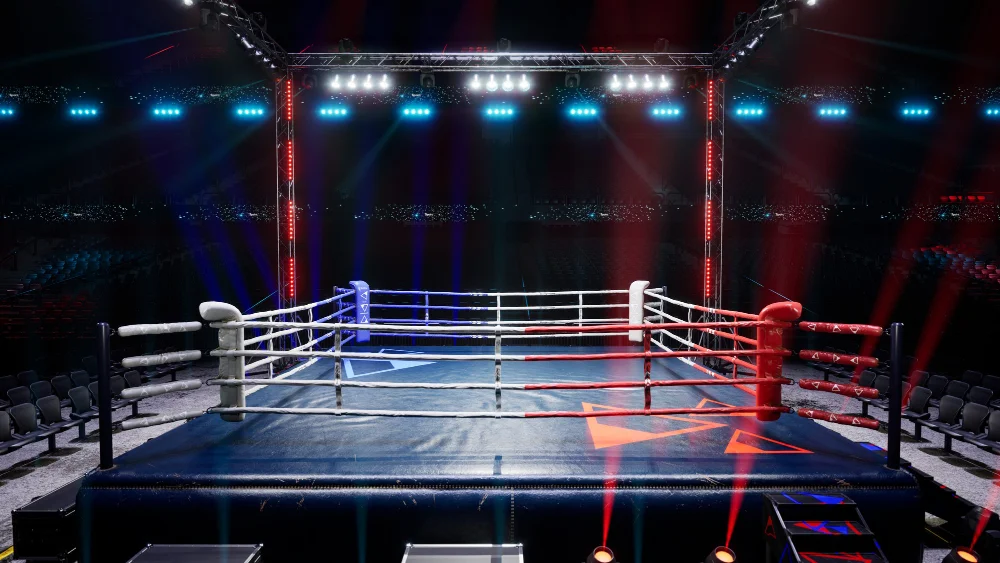
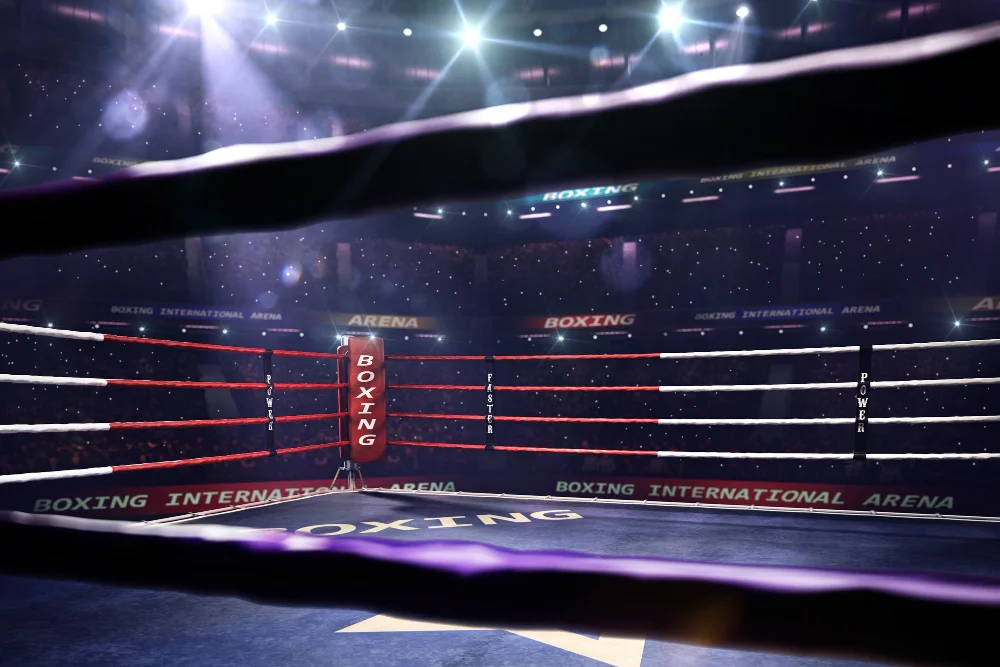
Boxing lighting design should consider the ring dimensions, elevated platform height, ropes, corner posts, fighter movement, referee positions, judges, spectator seating, camera locations, and the geometry of the ceiling or truss structure. Fixtures should be positioned to deliver effective illumination to the ring from appropriate directions while helping to minimise excessive glare, harsh shadows, and visual obstruction for fighters, officials, spectators, and cameras.


Training, Competition and Broadcast Boxing
Different boxing venues can require different lighting performance.
Projects may involve:
- boxing training gyms
- sparring rings
- amateur competition
- club events
- professional boxing
- televised events
- multipurpose arenas.
A training ring does not automatically require the same lighting criteria as an internationally televised boxing event.
The level of competition and broadcast requirements should therefore be confirmed before final design targets are established.
Ring Canvas Lighting
The ring canvas is the main horizontal visual surface.
Lighting should support clear visibility of:
- boxer footwork
- referee movement
- ring boundaries
- sponsor markings where applicable
- dropped equipment or objects.
Horizontal illumination is therefore important, but it is only one part of the complete boxing-lighting design.
Vertical Illumination
Boxers and referees are vertical subjects.
Broadcast cameras and spectators need to see:
- faces
- gloves
- body movement
- punches
- referee signals.
A ring can appear bright on the canvas while fighters remain poorly modelled if vertical illumination is weak.
Where professional or broadcast use is intended, vertical lighting should therefore be evaluated in the relevant viewing directions.
Boxer Visibility From Multiple Directions
Boxing action continuously changes direction.
One fighter may be facing one camera while the opponent is facing another.
Lighting should therefore provide useful visibility from more than one direction rather than creating one dominant front-lit side.
This can also help reduce very hard shadows across faces and bodies.
Fighter Sightlines and Glare
Boxers regularly look:
- directly ahead
- upward during close exchanges
- toward corners
- toward elevated fixtures.
High-output luminaires positioned directly within these viewing directions can create discomfort or interfere with visibility.
Lighting design should therefore evaluate glare from actual fighter positions, not only from spectator seating.
Overhead Lighting Geometry
Boxing rings are often illuminated using:
- ceiling-mounted fixtures
- suspended trusses
- arena rigging
- structural grids.
The relationship between fixture height, beam angle and ring dimensions determines how the light reaches the competition area.
Too narrow a distribution can create hot spots.
Too wide a distribution can waste light outside the ring or reduce the visual separation between the ring and surrounding arena.
Truss-Mounted Lighting
Temporary and professional boxing events frequently use overhead trusses or event rigging.
Lighting coordination may need to consider:
- truss location
- rigging load
- fixture weight
- cable routing
- fixture aiming
- speaker and AV equipment
- camera clearance.
Structural rigging acceptance remains the responsibility of the applicable project engineering and event requirements.
VS Wilson should not make universal rigging-capacity claims.
Ceiling-Mounted Boxing Lighting
Permanent boxing gyms may use fixed ceiling-mounted systems instead of temporary trusses.
Design should consider:
- ceiling height
- structural positions
- exposed services
- ring location
- future ring relocation
- maintenance access.
If the ring moves substantially after the lighting layout has been fixed, the photometric design may need to be reviewed.
Rope and Corner Shadows
Ring ropes, corner posts and fighters can interrupt light.
Poor fixture geometry can create unwanted shadows across:
- canvas
- boxer bodies
- referee positions
- ring corners.
Lighting from suitable multiple directions can help reduce dominant shadows.
However, eliminating every visible shadow is neither necessary nor always practical.
The design objective is controlled visibility rather than a shadow-free guarantee.
Corner Lighting
Ring corners can become visually weaker than the centre if the lighting layout is concentrated too tightly above the middle of the ring.
The design should therefore consider:
- neutral corners
- red and blue corners where applicable
- stool areas
- referee movement around the full ring.
Uniformity across the complete competition area should be checked rather than assuming the centre represents the entire ring.
Referee Visibility
The referee needs to observe:
- punches
- boxer condition
- fouls
- knockdowns
- corner activity.
Lighting should therefore provide useful facial and body visibility without excessive shadows.
The referee should not become a large moving shadow source because all illumination originates from one direction.
Judges and Ringside Visibility
Judges and officials are normally positioned around the ring.
Their visual requirements differ from those of the fighters.
Ring lighting should support clear observation of the bout while controlling direct glare from elevated fixtures.
Ringside luminaires, score displays and broadcast equipment should also be coordinated with the lighting layout.
Spectator Visibility
In an arena, the ring should remain the primary visual focus.
Surrounding audience areas can be lit separately according to venue requirements.
Over-lighting the entire audience area can reduce visual focus on the ring, while excessively dark circulation may create operational or safety problems.
Ring, spectator and circulation lighting should therefore be treated as coordinated but separate lighting layers.
Broadcast Boxing Lighting
Televised boxing introduces additional requirements.
These may include:
- vertical illuminance
- uniformity
- colour rendering
- colour temperature
- flicker performance
- slow-motion replay
- multiple camera directions
- background lighting.
An event should only be described as broadcast compliant after the applicable broadcaster or governing-body requirements have been confirmed and tested.
Camera Position Planning
Boxing broadcasts can use:
- ringside cameras
- elevated cameras
- corner cameras
- handheld cameras
- overhead cameras
- wider arena cameras.
The ring can therefore be viewed from many different directions.
Vertical illumination should be considered against the actual broadcast plan where available.
Slow-Motion and High-Speed Cameras
Boxing broadcasts rely heavily on slow-motion replay.
LED lighting can appear visually steady to spectators while still producing modulation visible on high-frame-rate cameras.
Where high-speed recording is required, the selected luminaire and driver performance should therefore be verified against the actual camera and production requirements.
LED technology alone does not guarantee flicker-free slow-motion footage.
Colour Rendering
Accurate colour appearance can matter for:
- boxer skin tones
- gloves
- trunks
- corner colours
- referee clothing
- sponsor branding
- television production.
Older IBA event guidance specifically identified good colour rendering as important for video and television recording.
The actual colour-rendering specification should follow the current event or broadcast requirement and selected luminaire documentation.
Colour Temperature
Colour temperature can affect:
- camera white balance
- skin appearance
- canvas appearance
- arena atmosphere.
There is no single colour temperature that should automatically be applied to every boxing venue.
The final CCT should follow the project and broadcast requirements.
DIALux and Photometric Design
Where applicable, VS Wilson can use DIALux and photometric calculations to evaluate the boxing-ring lighting arrangement.
Depending on project requirements, calculations may consider:
- horizontal illumination on the ring
- vertical calculation surfaces
- uniformity
- fixture positions
- beam overlap
- bright and dark zones
- relevant glare conditions
- surrounding arena spill.
The model should use actual ring dimensions, fixture mounting height and selected luminaire photometric files.
Sample DIALux Report
A client-provided DIALux PDF will be published in the service-page evidence tab.
VIEW SAMPLE DIALux REPORT
This representative report demonstrates VS Wilson's photometric-design process. The sample relates to the project type identified in the report. Every project requires a separate design based on its venue, operating conditions and intended use.
The report must retain its actual project type and must not be presented as completed Boxing Ring Lighting evidence unless it genuinely relates to that project.
What Lux Level Does a Boxing Ring Need?
There is no single universal lux requirement suitable for every boxing ring.
Lighting criteria can differ according to:
- training
- local competition
- professional competition
- television coverage
- event rules
- governing-body requirements.
Historical IBA event guidance has published different lighting classes for boxing and separate horizontal and vertical requirements, demonstrating that the level of event matters.
Current project requirements should always be verified against the applicable competition and broadcast documentation.
VS Wilson therefore does not publish one universal boxing-ring lux value.
Why Old Boxing Lux Tables Should Not Be Used as a Universal Sheffield Rule
Historical boxing-event documents can be useful technical references.
For example, an older IBA Event Operational Manual published multiple boxing lighting classes and required vertical illumination in addition to horizontal ring illumination.
However, that document is not a universal current Sheffield building or event specification.
Current event requirements should be confirmed from the organiser, governing body, broadcaster and venue consultant.
Training Gym Ring Lighting
A boxing training facility normally has different priorities from a major broadcast arena.
Design may focus on:
- clear sparring visibility
- coach observation
- glare control
- ring uniformity
- surrounding training areas.
Full broadcast-camera requirements may not be necessary.
Professional Competition Lighting
Professional events may require additional coordination with:
- event production
- television cameras
- trusses
- sound equipment
- score systems
- ringside officials.
Temporary competition layouts should be reviewed as a complete event configuration.
Permanent Versus Temporary Boxing Lighting
Permanent boxing gyms and temporary event rings can require different execution approaches.
Permanent Installations
May use:
- fixed ceiling points
- dedicated circuits
- permanent controls
- integrated lighting layouts.
Temporary Event Installations
May involve:
- rigging
- temporary trusses
- temporary power distribution
- event control
- rapid setup and dismantling.
The applicable structural and electrical approvals must follow the actual venue and event requirements.
Arena Lighting Balance
A boxing arena can include:
- ring lighting
- spectator lighting
- entrance lighting
- circulation
- broadcast lighting
- event effects.
These systems should not automatically operate at the same level.
The competition ring can remain visually dominant while other zones operate according to their own requirements.
Event and Show Lighting
Professional boxing events may use entertainment lighting around:
- fighter entrances
- audience
- stage elements
- introductions.
These show-lighting effects are separate from the core competition lighting needed during the bout.
Dynamic effects should not compromise competition visibility or broadcast requirements.
Lighting Controls and Event Modes
Where compatible equipment is specified, control modes may include:
- setup
- training
- competition
- broadcast
- audience entry
- event presentation
- cleaning.
The exact modes should follow venue and event requirements.
Emergency Lighting Is Separate
Boxing competition lighting is not the same as emergency or life-safety lighting.
The venue may require separate emergency systems for:
- exits
- spectator aisles
- stairs
- concourses
- escape routes.
Normal ring lighting and show-lighting controls should not be presented as replacements for required life-safety systems.
Power Distribution
Temporary and permanent boxing installations both require appropriate electrical planning.
Depending on project scope, this may include:
- lighting circuits
- distribution boards
- control circuits
- cable routing
- load allocation
- isolation.
For broadcast or professional events, continuity requirements should be established from the venue and event brief.
No universal redundancy or backup-power configuration should be assumed.
New Boxing Facilities
For new boxing gyms or arenas, early lighting planning can coordinate:
- ring position
- ceiling structure
- trusses
- electrical points
- ventilation
- sprinklers
- speakers
- cameras
- seating.
This reduces the likelihood of fixtures later being moved into less suitable positions.
Existing Boxing Ring Retrofit
Existing facilities can also be assessed for lighting upgrades.
Retrofit reasons may include:
- poor ring uniformity
- glare
- inadequate vertical visibility
- excessive shadows
- old fixtures
- changed ring location
- new broadcast requirements.
A retrofit should be based on recalculation and current ring geometry rather than simply replacing old luminaires by wattage.
Multi-Brand Fixture Sourcing
VS Wilson can source boxing-ring lighting products according to project specification, client preference, documentation and market availability.
Possible products may include:
- directional luminaires
- sports floodlights
- narrow or medium-beam fixtures
- drivers
- dimming equipment
- compatible control components
- associated electrical materials.
Selection may consider:
- photometric distribution
- glare control
- colour quality
- flicker performance
- dimming capability
- mounting conditions
- thermal requirements.
Actual lifetime, warranty, enclosure rating and performance remain manufacturer-specific.
Electrical Installation
VS Wilson can undertake electrical installation according to the agreed boxing-lighting scope.
Depending on the project, work may include:
- lighting circuits
- cabling
- fixture mounting
- electrical connections
- controls
- dimming
- fixture aiming.
Rigging or structural attachment should follow the approved structural and venue requirements.
Final Aiming
A boxing-ring design is highly sensitive to final fixture direction.
Incorrect aiming can create:
- centre hot spots
- dark corners
- boxer glare
- hard shadows
- poor vertical visibility
- excessive audience spill.
Final aiming should therefore follow the approved photometric arrangement and be checked on site.
Testing and Commissioning
Commissioning may include:
- luminaire operation
- electrical circuits
- controls
- dimming
- operating modes
- ring uniformity
- visible glare
- fixture aiming.
For competition or broadcast projects, photometric measurements should follow the applicable event or production measurement criteria.
A few random readings should not be represented as full competition compliance testing.
Common Boxing Ring Lighting Problems We Assess
The Centre Is Bright but the Corners Are Dark
Fixture beams are concentrated too tightly in the centre of the ring.
Fighters See Direct Glare
Overhead luminaires intersect common upward or forward sightlines.
Strong Shadows Follow the Fighters
Lighting reaches the ring from too few useful directions.
Ropes Create Distracting Shadows
Beam geometry has not accounted for ring ropes and corner structures.
Ring Canvas Looks Good but Faces Are Dark
Horizontal illumination has been prioritised while vertical visibility is weak.
Cameras Produce Inconsistent Images
Lighting differs significantly between camera directions.
Slow-Motion Video Shows Flicker
Luminaire or driver performance does not match high-frame-rate production requirements.
Truss Layout Conflicts With Lighting
Fixtures, speakers and production equipment compete for the same mounting positions.
Audience Lighting Overpowers the Ring
Arena lighting does not maintain a clear visual hierarchy.
Temporary Setup Is Not Recalibrated
Fixtures are installed based on a previous event instead of the current ring and truss geometry.
Retrofit Is Based Only on Fixture Wattage
Existing optical or layout problems remain after replacement.
No Final Ring Verification
The system is considered complete because all fixtures switch on, even though aiming and ring distribution remain incorrect.
What Determines Boxing Ring Lighting Cost in Sheffield?
Boxing-ring lighting cost depends on the venue and intended use.
Factors may include:
- ring quantity
- competition level
- training versus broadcast use
- ceiling height
- permanent or temporary installation
- truss or structural requirements
- fixture quantity
- fixture specification
- controls
- dimming
- broadcast requirements
- electrical infrastructure
- installation access
- DIALux or design scope
- testing and commissioning.
A project-specific quotation should therefore follow review of the ring and venue conditions.
Information Helpful for a Boxing Lighting Proposal
Where available, provide:
- Sheffield project location
- ring dimensions
- ring/platform height
- venue floor plan
- ceiling height
- ceiling or truss drawings
- spectator layout
- event level
- governing-body requirements
- camera positions
- broadcast requirements
- electrical drawings
- available power
- control requirements
- existing lighting details for retrofit
- project or event programme.
VS Wilson Boxing Ring Lighting Project Process
1. SITE ASSESSMENT
Review ring geometry, venue conditions, viewing positions and project requirements.
2. DRAWING REVIEW
Review ring, ceiling, truss, electrical, spectator and camera information.
3. LIGHTING PLANNING
Define fixture locations, ring criteria, viewing directions and operating requirements.
4. PHOTOMETRIC DESIGN
Carry out DIALux or applicable boxing-ring lighting calculations.
5. PRODUCT SOURCING
Source suitable lighting fixtures and associated project materials.
6. ELECTRICAL INSTALLATION
Execute approved lighting and electrical work according to the project scope.
7. SYSTEM TESTING
Test fixtures, circuits and applicable controls.
8. FINAL COMMISSIONING
Complete aiming, applicable photometric checks and handover.
Why Boxing Ring Lighting Design and Installation Need to Stay Connected
Boxing-ring photometric performance depends on actual:
- ring position
- fixture height
- truss geometry
- beam distribution
- aiming
- camera positions.
If those conditions change during installation or event setup, the completed lighting can differ substantially from the original design.
VS Wilson can coordinate lighting planning, product sourcing, electrical installation, testing and commissioning within one agreed project scope.
Boxing Ring Lighting Across Sheffield
VS Wilson operates from Dubai and provides boxing-ring lighting project services in Sheffield.
Projects elsewhere are handled through project mobilisation and service delivery according to the agreed scope. Service availability does not imply a permanent local office.
Project Evidence
Only verified first-party evidence should be presented here.
Sample DIALux Report
A client-provided DIALux PDF can demonstrate VS Wilson's photometric-design process.
VIEW SAMPLE DIALux REPORT
The report must retain its genuine project type and must not be presented as completed Boxing Ring Lighting evidence unless it genuinely relates to that project.
Verified Project Photographs and References
Ring, arena and event names, photographs, locations, client identities and references should be added only after verification and publication approval.
Until then, representative boxing imagery must not be labelled as completed VS Wilson project work.
Frequently Asked Questions
What is boxing ring lighting?
Boxing ring lighting is the planned illumination of a boxing ring to support fighter, referee, official, spectator and—where applicable—broadcast visibility.
Does VS Wilson provide boxing ring lighting across Sheffield?
Yes. VS Wilson provides lighting consultation, design, multi-brand sourcing, electrical installation, testing and commissioning across Sheffield according to the agreed project scope.
What lux level does a boxing ring require?
There is no single universal lux value. Requirements depend on training, competition, governing-body and broadcast requirements.
Why is vertical lighting important for boxing?
Vertical illumination helps fighters, referees and their movements remain clearly visible from spectator and camera viewing directions.
Why is glare important in boxing lighting?
Fighters move through changing viewing angles and can look toward overhead fixtures, so poorly positioned high-output lights can affect visual comfort.
Can boxing-ring lighting be mounted on a truss?
Yes, where the venue, rigging design and approved structural requirements allow it.
Can boxing lighting be designed for television?
Yes, where the project provides the applicable broadcast requirements. Broadcast compliance should only be claimed after those requirements have been verified.
Why does flicker matter in boxing?
High-speed and slow-motion cameras can reveal light-output modulation that may not be visible to spectators.
Does VS Wilson use DIALux for boxing-ring lighting?
Yes. DIALux and photometric calculations are available where applicable and where sufficient venue and luminaire information is available.
How can shadows across the ring be reduced?
Using suitable fixture positions, beam distributions and lighting from appropriate directions can reduce excessive or dominant shadows.
Is training-gym lighting the same as professional boxing-event lighting?
No. Training, competition and broadcast environments can require different performance and control conditions.
Can an existing boxing gym be upgraded?
Yes. Existing rings can be assessed for retrofit based on ceiling geometry, fixture locations, electrical infrastructure, glare and current lighting performance.
Can temporary boxing events use the same lighting layout every time?
Not necessarily. Changes in ring position, truss height, cameras and venue geometry can require recalculation or re-aiming.
Does LED boxing lighting guarantee energy savings?
No fixed saving should be guaranteed. Actual consumption depends on connected load, operating hours, controls and the previous lighting system.
How much does boxing ring lighting cost in Sheffield?
Pricing depends on ring type, competition level, mounting arrangement, fixtures, controls, electrical work, broadcast requirements and commissioning scope.
Discuss Your Boxing Ring Lighting Project
Planning lighting for a boxing gym, competition ring, arena or temporary boxing event in Sheffield?
Share your ring dimensions, venue drawings, ceiling or truss information, competition level, broadcast requirements and electrical details with VS Wilson.
Our team can review the project and establish the appropriate scope for boxing ring lighting planning, DIALux or photometric design where applicable, fixture sourcing, electrical installation, aiming, testing and commissioning.
To know more about VS Wilson and our expertise, visit our About Us page. For more information, project requirements, or enquiries about our lighting solutions, Contact VS Wilson today.
Image Gallery