Modern Driveway Lighting Solutions in Leeds
VS Wilson provides modern driveway lighting solutions across Leeds, covering site assessment, lighting planning, DIALux and photometric calculations where applicable, outdoor fixture sourcing, electrical coordination, installation, testing and final commissioning.
The lighting design is developed around the actual driveway layout, vehicle movement, turning areas, gate and entrance sequence, landscape features, pedestrian routes and surrounding architecture.
Depending on the project, the solution can include recessed driveway lights, bollards, landscape-integrated lighting, LED fixtures, wall-mounted lighting, feature lighting and controlled illumination around gates and entrances.
The service is suitable for new villas and residential developments as well as existing driveways requiring lighting upgrades or retrofit work.
Driveway Lighting Planning Priorities
Modern driveway lighting should be planned around vehicle movement, pedestrian access, entrance sequencing and the surrounding landscape rather than fixture spacing alone. Coordinating these elements from the design stage helps create a clearer relationship between the driveway route, gate, property entrance and outdoor environment while supporting practical illumination requirements.
What Are Modern Driveway Lighting Solutions?
Modern driveway lighting combines functional outdoor illumination with architectural and landscape design.
A driveway lighting system may be used to: Define driveway edges, Support vehicle movement, Improve visibility around turns, Highlight entry routes, Identify changes in level, Connect the gate to the property entrance, Coordinate with landscape planting, Highlight architectural features, Provide controlled decorative illumination
The final arrangement should be based on the actual driveway geometry rather than simply placing fixtures at equal distances.


Driveway Lighting Design in Leeds
Driveways in Leeds properties can vary considerably in width, length, surface, landscape arrangement and entrance configuration.
A proper design can review:
- Driveway dimensions
- Vehicle entry and exit routes
- Turning areas
- Gate location
- Property entrance
- Pedestrian access
- Parking areas
- Landscape boundaries
- Planting zones
- Walls and columns
- Changes in level
- Paving materials
- Existing electrical infrastructure
This allows the lighting system to support movement while maintaining the intended appearance of the property.
Villa Driveway Lighting
Villa driveway lighting can be planned around the complete arrival sequence:
Gate → Driveway → Turning Area → Parking/Approach → Entrance
Lighting can be used to visually connect these zones without making every part of the property equally bright.
Depending on the villa design, the system may include:
- Recessed ground lights
- Bollards
- Low-level landscape fixtures
- Wall lights
- Architectural accent lighting
- Entry lighting
- Feature lighting
The final arrangement depends on the property’s architecture, landscape design and driveway configuration.
Luxury Driveway Lighting
For luxury residential properties, driveway lighting often needs to perform both a functional and decorative role.
The design can coordinate lighting with:
- Villa facade
- Gate design
- Boundary walls
- Landscape features
- Trees and planting
- Water features
- Paving
- Entrance columns
- Architectural details
The objective is to make the approach visually coherent without allowing driveway fixtures to overpower the property.
Modern Driveway Edge Lighting
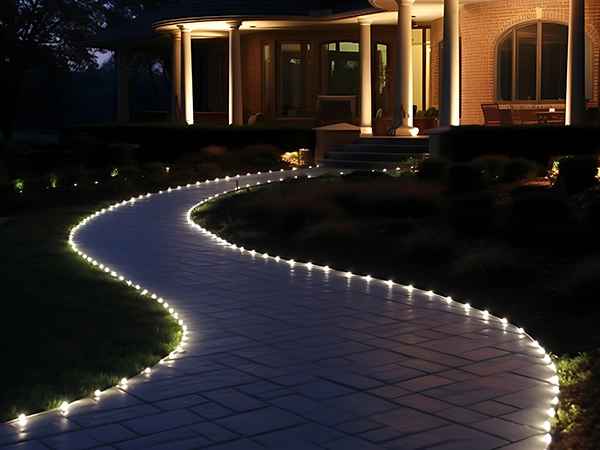
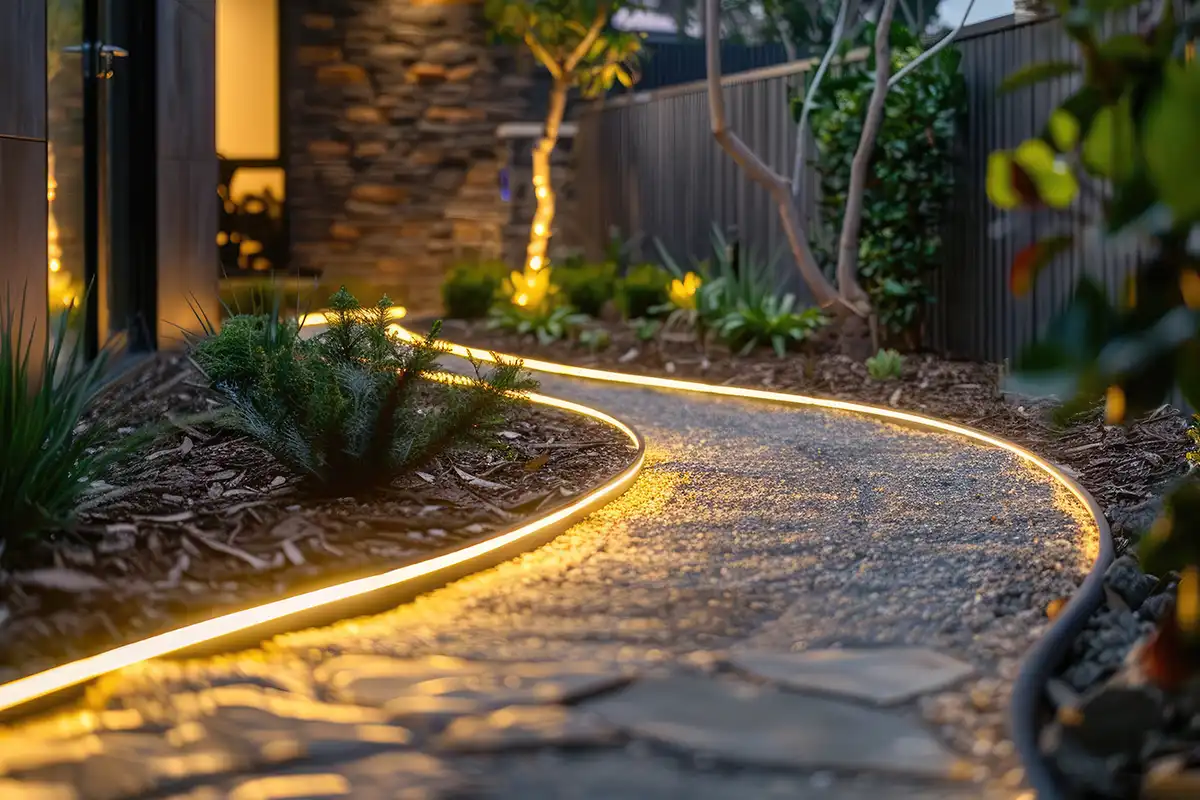
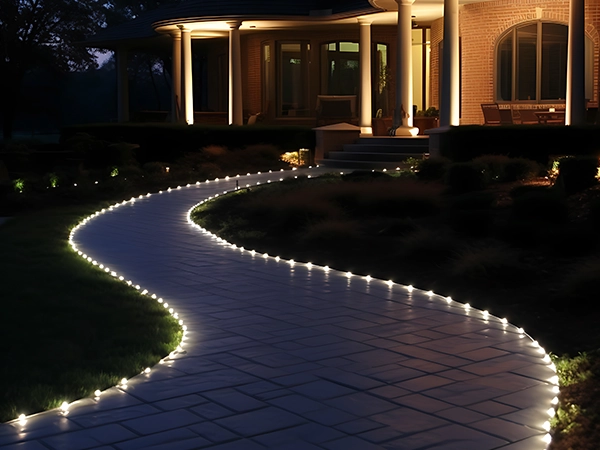
Edge lighting can help visually define the route of a driveway.
Possible solutions include:
- Recessed ground fixtures
- Bollards
- Low-level landscape lights
- Linear lighting
- Integrated edge lighting
Fixture positioning should account for driveway width, vehicle movement, landscaping and pedestrian circulation.
Recessed Driveway Lighting
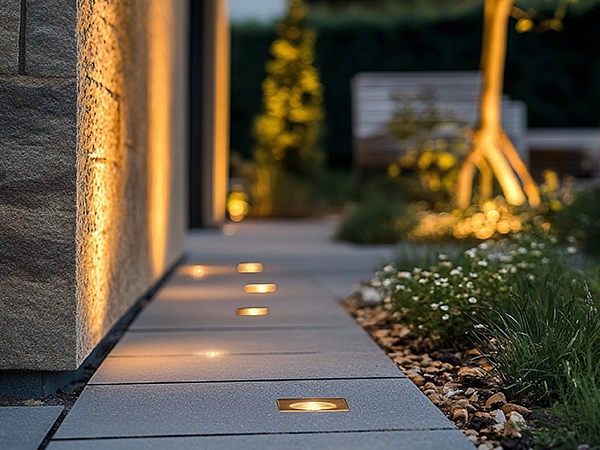
Recessed fixtures can be integrated into suitable ground or paving locations to create a low-profile lighting appearance.
Before specifying recessed fixtures, the project should be assessed for:
- Paving construction
- Drainage
- Cable routing
- Fixture access
- Installation depth
- Traffic/loading conditions
- Water exposure
- Maintenance access
The selected product should be appropriate for the actual installation environment rather than assuming one enclosure rating for every project.
Bollard Lighting for Driveways
Bollard lighting can provide low-level illumination along driveway edges, pedestrian routes and landscape boundaries.
Bollard placement should consider:
- Vehicle clearance
- Pedestrian movement
- Planting
- Driveway width
- Sightlines
- Gate operation
- Landscape design
- Maintenance access
The objective is to guide movement without creating unnecessary visual obstruction.
LED Driveway Lighting
LED luminaires can be considered for driveway and landscape applications based on the required performance, fixture design, controls, electrical compatibility and project conditions.
Potential applications include:
- Ground lights
- Bollards
- Linear lighting
- Wall lights
- Landscape fixtures
- Architectural accent lighting
Fixture selection should be based on the actual project specification rather than applying a universal product characteristic.
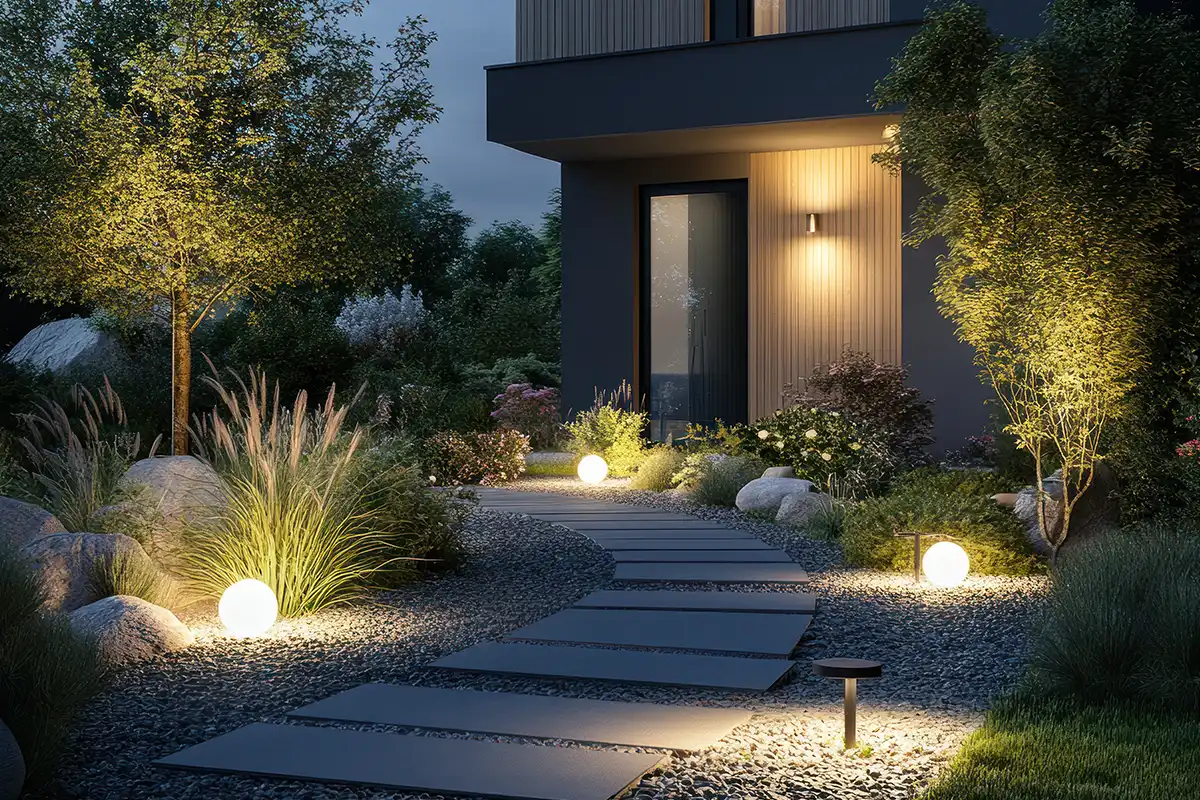
Landscape-Integrated Driveway Lighting
Driveway lighting often works together with landscape lighting.
The design can coordinate fixtures around:
- Planting beds
- Trees
- Shrubs
- Boundary walls
- Garden paths
- Water features
- Feature stones
- Retaining walls
This helps prevent the driveway from appearing visually separate from the surrounding landscape.
Driveway Gate Lighting
The gate is an important transition point between the street and the property.
Lighting can be planned for:
- Gate pillars
- Gate walls
- Entry signage
- Vehicle approach
- Pedestrian access
- Intercom/access-control areas
- Immediate driveway entry
Lighting should be positioned carefully so it does not create unnecessary glare for approaching drivers.
Driveway Entrance Lighting
The entrance section can connect driveway lighting with the building’s architectural lighting.
Possible elements include:
- Entrance wall lighting
- Column lighting
- Canopy lighting
- Door-area lighting
- Landscape accent lighting
- Pathway lighting
A coordinated lighting sequence can help transition from the driveway to the main property entrance.
Driveway Turning Area Lighting
Turning zones require particular attention because vehicle direction changes within a relatively concentrated area.
The design should consider:
- Turning radius
- Driveway width
- Parking access
- Boundary walls
- Landscape obstacles
- Fixture position
- Driver sightlines
Lighting should be distributed to avoid creating isolated bright spots surrounded by poorly illuminated areas.
Driveway Lighting & Vehicle Glare Control
Glare is an important consideration for driveway lighting because drivers are approaching the property while looking along the route.
Potential glare sources include:
- Directly visible bright lamps
- Poor fixture orientation
- Overly exposed light sources
- Fixtures positioned within driver sightlines
- Reflective paving or walls
- Incorrect beam direction
The design can address these conditions through fixture selection, shielding, mounting position, beam control, aiming and appropriate lighting levels.
Driveway Lighting & Shadows
A driveway lighting system should avoid creating unnecessary dark zones around:
- Turns
- Gate approaches
- Steps
- Changes in level
- Pedestrian crossings
- Parking areas
- Landscape boundaries
Fixture placement and beam distribution should be considered together rather than relying only on fixture quantity.
Driveway Lighting & Landscape Design
Landscape changes can alter how driveway lighting performs.
Trees, shrubs, planters and walls can:
- Block light
- Create shadows
- Hide fixtures
- Affect sightlines
- Change the appearance of illuminated surfaces
Lighting should therefore be coordinated with the landscape layout and any planned future planting.
Driveway Lighting & Paving
Ground-integrated fixtures require coordination with the actual paving system.
Considerations can include:
- Paving thickness
- Fixture dimensions
- Drainage
- Cable routes
- Junction points
- Access
- Surface loading
- Waterproofing
- Replacement access
The final installation method should be determined by the actual paving and site conditions.
Driveway Lighting & Waterproofing
Outdoor fixtures and electrical connections may be exposed to water, dust, irrigation and changing environmental conditions.
The design and installation should therefore consider:
- Product suitability
- Cable protection
- Junction-box location
- Connection methods
- Drainage
- Fixture installation details
- Water ingress risks
- Maintenance access
No universal IP rating should be assumed; the appropriate equipment should be selected according to the specific location and product documentation.
Driveway Lighting Cable Routing
Outdoor driveway lighting often requires careful cable planning.
The installation may involve:
- Underground cable routes
- Conduits
- Junction points
- Driver locations
- Distribution points
- Fixture connection points
- Trenching
- Coordination with irrigation
Cable routing should be planned before hard landscaping is completed wherever possible.
Driveway Lighting Trenching
Where underground installation is required, trenching should be coordinated with the driveway and landscape works.
The installation plan may need to consider:
- Existing utilities
- Irrigation lines
- Drainage
- Paving
- Soil conditions
- Cable protection
- Access points
- Reinstatement requirements
The actual trenching method should follow the approved project design and site conditions.
Driveway Lighting Controls
Driveway lighting can be divided into control zones according to the property layout.
Possible control arrangements include:
- Manual switching
- Timers
- Photocell-based controls
- Motion detection
- Dimming
- Smart-home integration
- Separate gate and driveway zones
The design and installation must follow the applicable local building, electrical, fire-safety and project-authority requirements.
Smart Driveway Lighting
For properties with home automation, driveway lighting can potentially be integrated with broader control systems.
Depending on the selected equipment and project requirements, controls may include:
- Scheduled operation
- Dimming
- Motion-based activation
- Scene control
- App-based operation
- Integration with property automation
- Separate entrance and landscape zones
Compatibility between luminaires, drivers and control equipment should be verified before procurement.
DIALux Driveway Lighting Design
Where applicable, VS Wilson can use DIALux and photometric calculations to assess the proposed driveway lighting arrangement.
The design can evaluate:
- Driveway geometry
- Fixture positions
- Lighting distribution
- Turning areas
- Entry points
- Surrounding surfaces
- Landscape influence
- Alternative fixture arrangements
- Potential dark zones
- Glare considerations
The final design remains project-specific and should be based on the actual site geometry, selected luminaires and project requirements.
Inputs Required for DIALux Driveway Lighting Design
Useful inputs can include:
- Site plan
- Driveway dimensions
- Property layout
- Gate location
- Entrance location
- Landscape plan
- Parking layout
- Paving details
- Fixture photometric files
- Proposed fixture positions
- Existing electrical drawings
- Control requirements
- Architectural elevations
- New-build or retrofit status
Accurate site information helps align the lighting calculation with the proposed installation.
Driveway Lighting Product & Fixture Sourcing
VS Wilson can source suitable lighting products according to the approved design, client requirements, product documentation and market availability.
Potential products include:
- Recessed ground lights
- Bollards
- Outdoor wall fixtures
- Linear lighting
- Landscape fixtures
- LED flood or accent fixtures
- Drivers
- Controls
- Junction accessories
- Mounting components
Multi-brand sourcing can be considered where appropriate to the project.
Electrical Coordination for Driveway Lighting
Outdoor driveway lighting can require coordination between lighting, electrical and landscape works.
Electrical coordination may cover:
- Circuit planning
- Cable routes
- Underground wiring
- Driver locations
- Distribution points
- Control wiring
- Earthing
- Junction points
- Fixture connections
- Load requirements
The design and installation must follow the applicable local building, electrical, fire-safety and project-authority requirements.
Driveway Lighting Installation in Leeds
VS Wilson can manage driveway lighting installation as part of an end-to-end project scope.
Installation may include:
- Site verification
- Setting out fixture locations
- Coordination with landscape and civil works
- Trenching where required
- Cable and conduit installation
- Fixture mounting
- Driver and control installation
- Electrical connections
- Fixture alignment
- Initial system testing
- Final adjustment
- Commissioning
New Driveway Lighting Projects
For new properties, driveway lighting should ideally be planned before paving and landscape works are completed.
Early coordination can allow:
- Underground routes to be planned
- Fixture positions to be set out
- Electrical points to be coordinated
- Landscape lighting to be integrated
- Gate lighting to be included
- Control zones to be established
- Drainage conflicts to be identified
This can reduce the need to cut or remove finished paving later.
Existing Driveway Lighting Retrofit
Existing driveway lighting can be upgraded following a site assessment.
The assessment may review:
- Existing fixtures
- Existing wiring
- Cable routes
- Distribution equipment
- Gate position
- Current driveway layout
- Landscape changes
- Existing controls
- Paving conditions
- Fixture mounting locations
The retrofit solution should be based on what can safely and practically be reused.
Driveway Lighting Retrofit Without Full Landscape Replacement
Some projects may allow existing infrastructure to be retained while replacing selected fixtures or controls.
Other projects may require new cable routes, trenching or changes to fixture positions.
The actual retrofit scope should therefore be confirmed after site inspection rather than assuming that every driveway can be upgraded without civil or landscape work.
Driveway Lighting for Residential Villas
Villa driveway lighting can cover:
- Gate approach
- Main driveway
- Turning areas
- Parking access
- Pedestrian routes
- Landscape edges
- Villa entrance
- Boundary walls
The system can be designed to coordinate with the architectural and landscape character of the property.
Driveway Lighting for Gated Properties
Gated properties may require lighting at multiple transition points.
A coordinated system can address:
- External gate approach
- Gate opening area
- Security/access-control area
- Driveway
- Turning area
- Parking
- Main entrance
Lighting around access points should be coordinated with vehicle movement and sightlines.
Commercial Driveway Lighting
Driveway lighting can also be used for:
- Commercial properties
- Hospitality entrances
- Residential developments
- Private compounds
- Property access roads
- Building entry areas
The design should reflect the actual traffic, access and operating conditions of the site.
Leeds Environmental & Site Considerations
Environmental conditions, weather exposure, corrosion risk, dust, moisture, temperature variation and maintenance requirements should be assessed for the individual site.
Product and installation decisions should therefore consider the actual site environment, including:
- Ambient temperature
- Fixture exposure
- Driver location
- Dust
- Water and irrigation
- Drainage
- Cable protection
- Paving conditions
- Maintenance access
- Equipment ventilation
The final equipment specification should follow the project requirements and relevant product documentation.
Driveway Lighting Testing
After installation, the lighting system should be tested against the approved project requirements.
Testing may include:
- Fixture operation
- Circuit operation
- Control operation
- Driver performance
- Switching
- Dimming where applicable
- Fixture alignment
- Lighting distribution
- Gate-area visibility
- Turning-area coverage
- Glare observations
Required adjustments should be completed before final handover.
Driveway Lighting Photometric Verification
Where photometric calculations have been prepared, the installed system can be reviewed against the approved design and project requirements.
Verification can help identify:
- Fixture-position differences
- Unexpected obstructions
- Changes in landscape
- Dark areas
- Excessive brightness
- Aiming issues
- Differences between the designed and installed condition
Any final adjustments should reflect actual site conditions.
Final Driveway Lighting Commissioning
Commissioning confirms that the installed driveway lighting system is operating according to the agreed project scope.
The final stage may include:
- Functional checks
- Control verification
- Fixture adjustment
- Night-time visual inspection
- System coordination
- Client walkthrough
- Handover documentation
What Affects Modern Driveway Lighting Cost in Leeds?
Driveway lighting cost depends on the actual design and installation conditions.
Key cost factors include:
- Driveway length and width
- Number of fixtures
- Fixture type
- Recessed versus surface/standing fixtures
- Bollards
- Landscape integration
- Gate lighting
- Cable length
- Trenching requirements
- Paving conditions
- Existing electrical infrastructure
- Control systems
- Smart-home integration
- Retrofit complexity
- Site access
- Testing and commissioning
- Product sourcing requirements
A project-specific quotation should therefore be prepared after reviewing the site and proposed lighting scope.
Modern Driveway Lighting Design & Installation Process
Step 1 — Site Assessment
Review the driveway layout, vehicle movement, gate, landscape and existing electrical conditions.
Step 2 — Drawing Review
Review site plans, architectural drawings, landscape drawings and electrical information where available.
Step 3 — Lighting Planning
Define driveway, gate, turning, pedestrian and landscape lighting zones.
Step 4 — Photometric Design
Prepare DIALux or other suitable calculations where applicable.
Step 5 — Fixture Selection
Select appropriate fixtures based on design intent, site conditions and project requirements.
Step 6 — Product Sourcing
Source fixtures, drivers, controls and associated materials.
Step 7 — Electrical & Civil Coordination
Coordinate cable routes, trenching, paving, drainage, irrigation and electrical infrastructure.
Step 8 — Installation
Install and align the lighting system at the project location.
Step 9 — Testing & Adjustment
Test the system and make required fixture, control and alignment adjustments.
Step 10 — Commissioning & Handover
Complete final checks and hand over the installed driveway lighting system.
What We Need to Prepare a Driveway Lighting Proposal
Useful information includes:
- Project location
- Site plan
- Driveway dimensions
- Gate location
- Property entrance
- Landscape plan
- Parking layout
- Paving details
- Existing lighting
- Existing electrical drawings
- Preferred lighting style
- Fixture preferences
- Control requirements
- Smart-home requirements
- New-build or retrofit status
- Project programme
- Site access conditions
- Available DIALux or lighting drawings
If complete drawings are not available, the project can be discussed based on the information currently available and the required site assessment.
Sample DIALux Evidence
VS Wilson can publish the client-provided DIALux PDF in the service-page evidence tab.
Button:
VIEW SAMPLE DIALux REPORT
If the supplied report relates to another sport or facility, publish this disclosure directly beside the evidence:
This representative report demonstrates VS Wilson’s photometric-design process. The sample relates to the project type identified in the report. Every project requires a separate design based on its venue, operating conditions and intended use.
The report must remain genuine and text-searchable, identify its actual project type, have confidential information redacted where required, and must not be renamed or presented as evidence of a different service.
VS Wilson Modern Driveway Lighting Capability
SITE ASSESSMENT
DRAWING REVIEW
LIGHTING PLANNING
PHOTOMETRIC DESIGN
PRODUCT SOURCING
ELECTRICAL INSTALLATION
SYSTEM TESTING
FINAL COMMISSIONING
PLAN — PROJECT ASSESSMENT
Assess the driveway, vehicle movement, entrance sequence, landscape and existing site conditions.
DESIGN — LIGHTING PLANNING
Develop coordinated driveway, gate, landscape and entrance lighting zones.
SOURCE — PRODUCT PROCUREMENT
Source suitable fixtures, controls and associated materials according to the approved project requirements.
DELIVER — INSTALLATION & HANDOVER
Coordinate installation, testing, adjustment and final commissioning.
Why Use an End-to-End Driveway Lighting Service?
Driveway lighting involves more than placing outdoor fixtures along a boundary.
The system needs to work with the driveway geometry, vehicle movement, gate, landscape, paving, electrical infrastructure and architectural entrance.
Handling assessment, design, sourcing, electrical coordination and installation within one project workflow helps maintain continuity between the proposed design and the finished installation.
VS Wilson provides lighting consultation, design, DIALux/photometric calculations where applicable, product sourcing, electrical installation, testing and commissioning across Leeds.
Modern Driveway Lighting Solutions FAQs
What are modern driveway lighting solutions?
Modern driveway lighting solutions involve planning, selecting, installing and commissioning lighting systems that support driveway visibility, vehicle movement, entrance definition and landscape integration.
What type of lighting can be used for a driveway?
Depending on the project, options can include recessed ground lights, bollards, wall lights, landscape fixtures, linear lighting and other suitable outdoor luminaires.
Can you design driveway lighting for villas?
Yes. Driveway lighting can be designed for villas, gated homes, residential developments and other properties according to the actual driveway, gate, landscape and entrance arrangement.
How do you prevent driveway lights from causing glare?
Fixture position, beam direction, shielding, aiming and the relationship between the light source and approaching drivers should be considered during design.
Can driveway lighting include landscape lighting?
Yes. Driveway lighting can be coordinated with planting, pathways, boundary walls, trees and other landscape features.
Can recessed driveway lights be installed in existing paving?
Potentially, but the feasibility depends on the paving construction, drainage, cable routes, fixture requirements and access for installation.
Can existing driveway lighting be upgraded?
Yes. Existing systems can be assessed for fixture replacement, control upgrades, rewiring or a more extensive retrofit depending on site conditions.
Do you provide DIALux design for driveway lighting?
DIALux and photometric calculations can be provided where applicable and where sufficient site and fixture information is available.
Can driveway lighting include motion sensors or timers?
Yes. Timers, motion-based controls, dimming and other control methods can be considered according to the project requirements and selected equipment.
How much does driveway lighting cost in Leeds?
Cost depends on driveway size, fixture type, number of fixtures, trenching, cable routes, paving conditions, controls, retrofit requirements, installation access and product selection.
Does VS Wilson install driveway lighting across Leeds?
Yes. VS Wilson operates from Dubai and provides lighting services across Leeds through project delivery and on-site mobilisation.
Discuss Your Modern Driveway Lighting Project
A driveway lighting system should be planned around the actual route, gate, turning areas, landscape and electrical infrastructure.
Share your site plan, driveway layout, landscape drawings or existing lighting information with VS Wilson to discuss the appropriate design, sourcing and installation scope for your Leeds project.
To know more about VS Wilson and our expertise, visit our About Us page. For more information, project requirements, or enquiries about our lighting solutions, Contact VS Wilson today.
Image Gallery