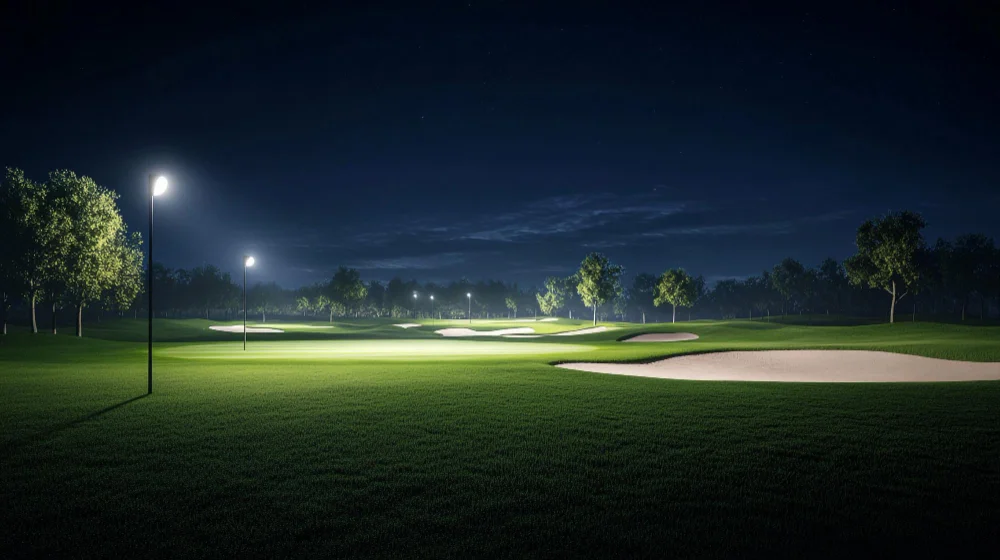
Golf Course Lighting in Győr
VS Wilson provides golf course and golf-practice lighting services across Győr for golf courses, par-three facilities, driving ranges, practice areas and other applicable golf environments.
Our scope can include site assessment, drawing review, lighting planning, DIALux and photometric calculations where applicable, multi-brand floodlight sourcing, pole and electrical coordination, installation, aiming, testing and final commissioning.
Golf course lighting is very different from illuminating a rectangular sports field.
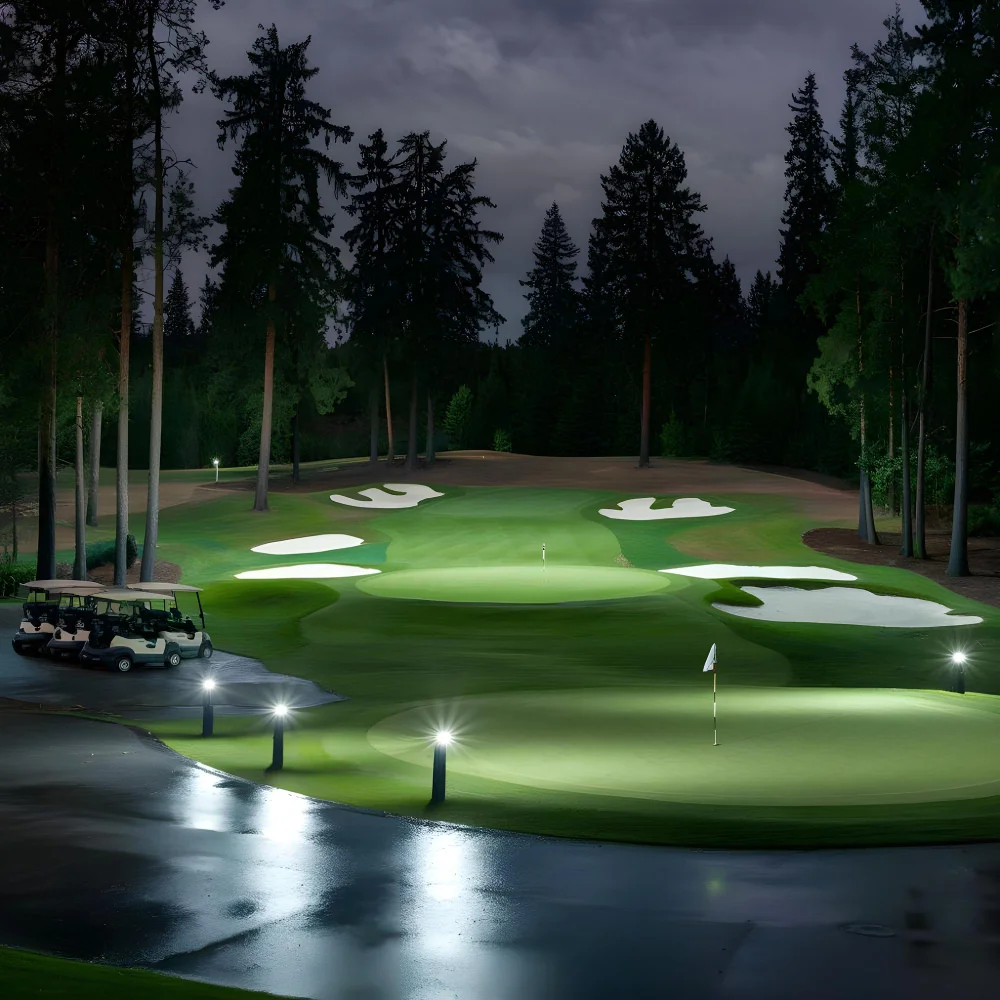
Golf facilities extend across large and irregular landscapes containing teeing areas, fairways, greens, bunkers, elevation changes, trees, water features, bends and long ball-flight paths.
The lighting system therefore needs to support both ground visibility and the player's ability to track the golf ball through the air while controlling glare and unwanted light outside the playing areas.
PLAN — PROJECT ASSESSMENT
DESIGN — LIGHTING PLANNING
SOURCE — PRODUCT PROCUREMENT
DELIVER — INSTALLATION & HANDOVER
Golf Lighting Designed Around the Course Layout
Each hole has a different geometry.
Golf course lighting planning may need to consider tee positions, fairway direction, landing zones, doglegs, greens, bunkers, rough areas, water hazards, elevation changes, surrounding vegetation, adjacent properties, and player sightlines. A single repeated pole-and-fixture arrangement is unlikely to suit every part of the course because each illuminated zone has different geometric and visual requirements. The lighting layout should therefore be developed around the actual course geometry and the specific conditions of each area.


Full-Course Lighting Versus Selective Lighting
Not every golf project requires every hectare of the course to be illuminated.
Some projects may involve:
- full night-golf coverage
- selected holes
- par-three courses
- practice areas
- driving ranges
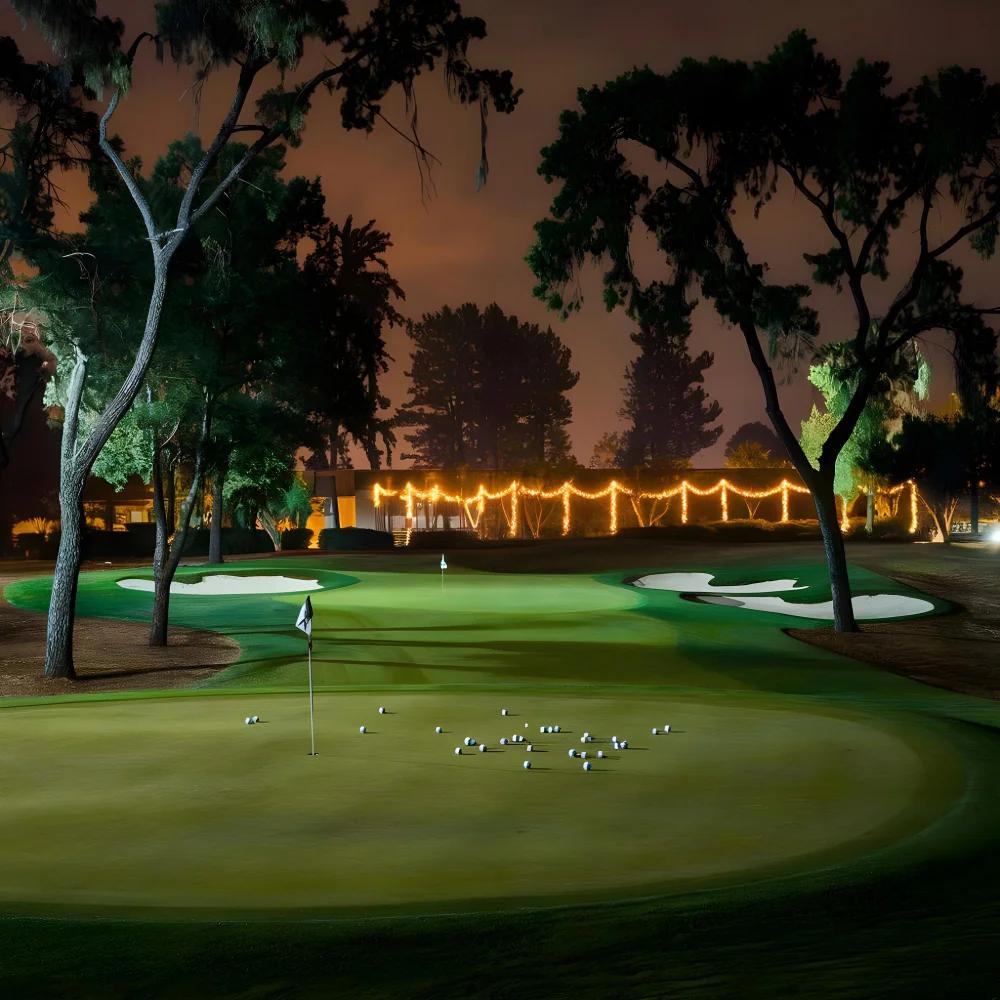
- putting greens
- short-game areas
Selective lighting can be appropriate where only particular areas operate after dark.
The final scope should be defined according to the course's real operating requirements.
Teeing Area Lighting
The teeing area requires useful visibility for:
- ball position
- club alignment
- stance
- surrounding tee surface
- direction of play
Lighting should also avoid placing high-intensity sources in distracting golfer sightlines.
The tee is only the beginning of the visual task; the golfer must also be able to follow the ball after impact.
Fairway Lighting
Fairways can extend over long and irregular distances.
Lighting design may need to account for:
- fairway width
- bends
- elevation changes
- trees
- bunkers
- landing areas
- overlapping coverage
Long-distance projection requires appropriate optics and aiming rather than simply increasing fixture wattage.
Green Lighting
Putting greens require clear visibility of:
- the putting surface
- flag position
- slopes and contours
- approach areas
- surrounding hazards
Lighting should support the green without creating excessive glare or flattening important visual cues.
The required photometric criteria should follow the actual project and intended level of use.
Bunkers, Berms and Terrain
Golf courses contain irregular terrain.
Bunkers, berms, depressions and slopes can produce shadowed areas if lighting is planned only from a simplified plan view.
Musco's golf guidance specifically identifies bunkers, berms and bends as areas requiring attention in night-golf lighting.
Lighting design should therefore account for terrain rather than assume a flat playing plane.
Ball Tracking in the Night Sky
One of the most important differences between golf lighting and many other outdoor applications is that the visual task continues above the ground.
Golfers and spectators may need to track the ball across a long aerial path against a dark sky.
Ground illuminance alone does not fully describe this requirement.
Lighting may therefore need to consider:
- vertical visibility
- upward ball illumination
- ball-flight direction
- golfer viewing position
- dark-sky contrast
Specialist golf systems sometimes use dedicated low-mounted or upward-directed lighting specifically to improve ball tracking. Musco's Omni PGA Frisco project, for example, used dedicated BallTracker fixtures to illuminate balls in flight.
VS Wilson should describe ball tracking as a design requirement, but should not claim any proprietary ball-tracking technology unless separately verified.
Driving Range Lighting
Driving ranges have their own lighting challenges because golfers repeatedly hit balls over long distances toward target zones.
The lighting design may need to consider:
- hitting bays
- first landing area
- distance markers
- target greens
- ball-flight visibility
- range perimeter
- surrounding properties
Where multiple hitting bays operate simultaneously, glare from adjacent poles and fixtures should also be reviewed.
Practice Putting and Short-Game Areas
Practice greens and short-game zones have different visual requirements from full fairways or driving ranges.
Lighting can focus on:
- surface visibility
- target identification
- player movement
- nearby bunkers
- pathways
Lower mounting or more localised lighting may sometimes be appropriate depending on the project.
Glare Control
Golfers frequently look upward and into long-distance sightlines.
Poorly positioned floodlights can interfere with:
- tee shots
- approach shots
- ball tracking
- putting
- spectator viewing
Glare control therefore needs to be considered from actual player positions.
Relevant factors include:
- pole position
- mounting height
- luminaire optics
- aiming direction
- shielding
- distance from the player
Pole and Mast Positioning
Golf-course pole positions must account for both photometric performance and the course itself.
Pole locations may need to avoid:
- primary player sightlines
- fairway play
- cart routes
- landscaping
- irrigation systems
- maintenance routes
- aesthetic viewpoints
Course appearance during daytime can also matter.
Large numbers of visible poles can alter the visual character of a golf environment.
The design should therefore balance lighting performance with practical and landscape constraints.
Pole Height and Optical Distribution
There is no universal mast height for golf-course lighting.
Appropriate height depends on:
- illuminated distance
- fairway width
- terrain
- pole location
- optic
- required coverage
- glare control
Different locations across the same course may require different solutions.
Light Spill and Neighbouring Properties
Golf courses can be located close to:
- residential developments
- hotels
- roads
- other sports facilities
- landscaped public areas
Uncontrolled sports lighting may produce:
- light trespass
- glare
- sky glow
- disturbance to nearby properties
Specialist golf-lighting guidance treats proximity to neighbours and adjacent roads as an important early design question.
Fixture optics, shielding, pole height and aiming should therefore be developed to keep light within the required playing areas as far as practical.
Any numerical spill limits should come from the actual authority or project criteria rather than a universal VS Wilson value.
Protecting the Night-Time Landscape
Golf courses are landscape environments as well as sports facilities.
The lighting system should avoid unnecessarily converting the entire site into a uniformly bright field.
Selective illumination can help retain:
- darker landscape zones
- visual depth
- course identity
- separation between active and inactive holes
This also supports more controlled light use around neighbouring properties and the night sky.
Trees and Vegetation
Existing vegetation can block or redirect light.
Lighting planning should therefore consider:
- mature trees
- palms
- landscaping
- future plant growth
- shadows across playing areas
Pole locations shown on drawings may need adjustment when actual site vegetation is reviewed.
Irrigation and Underground Services
Golf courses contain significant irrigation infrastructure.
Pole foundations, cabling and civil works should be coordinated with:
- irrigation pipes
- drainage
- underground utilities
- landscape systems
Early coordination reduces the risk of damaging completed course infrastructure.
Water Hazards
Water bodies can introduce:
- reflections
- restricted pole locations
- access constraints
- electrical considerations
Lighting should not be positioned purely for visual symmetry where terrain or water makes installation impractical.
DIALux and Photometric Design
Where applicable, VS Wilson can use DIALux and photometric calculations to evaluate proposed golf-course lighting.
Depending on the project, analysis may consider:
- teeing areas
- fairways
- greens
- practice areas
- driving ranges
- uniformity
- pole positions
- fixture aiming
- vertical calculation surfaces
- relevant glare
- spill-light conditions
The lighting model should use actual course geometry and selected luminaire photometric files wherever practical.
Sample DIALux Report
A client-provided DIALux PDF will be published in the service-page evidence tab.
VIEW SAMPLE DIALux REPORT
This representative report demonstrates VS Wilson's photometric-design process. The sample relates to the project type identified in the report. Every project requires a separate design based on its venue, operating conditions and intended use.
The sample must retain its genuine project type and must not be presented as completed Golf Course Lighting evidence unless it genuinely relates to that project.
No Universal Golf-Course Lux Level
There is no single lighting level that should automatically be applied to every golf project.
Required performance depends on:
- course type
- area being illuminated
- recreational or competition use
- practice versus full play
- broadcast requirements where applicable
- project or consultant criteria
A driving range, putting green and televised night tournament may require very different lighting performance.
VS Wilson therefore establishes project-specific design criteria rather than publishing one universal golf lux value.
Uniformity
Large brightness changes can make golf play more difficult after dark.
Uniformity can be important across:
- tees
- fairway landing zones
- greens
- practice areas
However, complete uniform brightness across an entire golf landscape is not always the design objective.
The required uniformity should apply to the relevant active playing areas according to the project criteria.
Broadcast Golf Lighting
Competition or televised night-golf projects may have additional requirements.
These can include:
- higher vertical illumination
- camera-facing visibility
- colour quality
- flicker performance
- spectator visibility
- temporary or permanent broadcast-lighting infrastructure
Musco's Shadow Creek broadcast project used dedicated vertical ball-tracking illumination and controlled glare while also providing lighting suitable for television coverage.
VS Wilson should only describe a project as broadcast-capable after the applicable broadcaster or event requirements have been established and achieved.
Colour Quality
Colour quality can affect:
- turf appearance
- ball visibility
- player visibility
- broadcast reproduction
The required CRI, colour fidelity or colour-temperature criteria should come from the actual project requirement and selected product documentation.
No universal colour specification should be applied to all golf facilities.
Controls and Zoned Operation
A golf course covers a large area, so lighting does not necessarily need to operate everywhere simultaneously.
Where compatible control systems form part of the project, zones can be created around:
- individual holes
- course sections
- driving ranges
- putting areas
- practice zones
- parking and access areas
Scheduling or sectional switching can support actual operating requirements.
Musco's golf solution also highlights the ability to switch off unused course sections as a specific night-golf consideration.
Dimming and Operating Modes
Where compatible fixtures and controls are specified, different operating modes may be possible.
These could include:
- maintenance
- practice
- recreational play
- competition
- event operation
The actual lighting levels and mode behaviour should be defined from project requirements.
Course Entrances, Paths and Parking
A night-golf project can also require lighting outside the actual playing areas.
This may include:
- entrances
- buggy/cart paths
- pedestrian routes
- club-house approaches
- parking
- service areas
These zones should be planned separately from golf-play lighting because their visual requirements are different.
Cart-Path Lighting
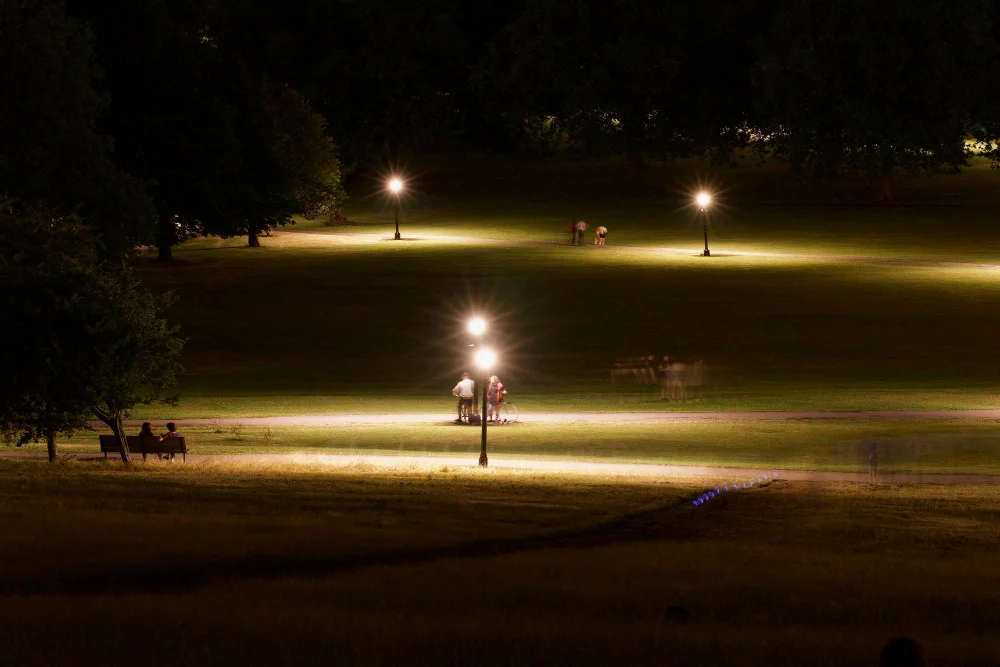
Cart paths need useful orientation without creating unnecessary glare toward adjacent fairways.
Depending on project scope, lighting may be:
- low-level
- pole-mounted
- integrated with landscape lighting
- selectively positioned at key movement areas
The solution should respond to terrain, path alignment and nearby play.
Győr Outdoor Conditions
Golf-course luminaires, poles and electrical equipment in Győr may be exposed to:
- high ambient temperatures
- direct solar exposure
- dust
- humidity
- irrigation
- coastal saline environments in some locations
- wind
Product suitability should be confirmed from actual manufacturer documentation.
VS Wilson should not apply one universal IP rating, corrosion classification, lifetime or warranty to every golf-lighting product.
New Golf-Course Lighting Projects
For a new course or new night-lighting scheme, early coordination can align:
- course design
- pole locations
- irrigation
- drainage
- landscape
- electrical routes
- controls
- club operations
This reduces the risk of installing foundations or cabling that later conflict with golf-course infrastructure.
Existing Course Lighting Retrofit
Existing golf facilities can also be assessed for LED or lighting-system upgrades.
Retrofit review may include:
- existing poles
- mast locations
- fixture condition
- electrical infrastructure
- current lighting distribution
- glare
- spill light
- ball visibility
- controls
A retrofit should not automatically retain the existing geometry if that geometry prevents the required performance.
Existing Pole Reuse
Existing poles may be reusable where suitable, but this depends on:
- structural condition
- pole height
- location
- luminaire weight
- wind load
- mounting interface
- new photometric requirements
A structural and project-specific assessment may therefore be required.
LED Golf Lighting Retrofit
An LED retrofit should not be based only on wattage comparison.
The proposed system should still be checked for:
- playing-area illumination;
- uniformity
- glare
- long-distance coverage
- ball tracking
- spill light
- controls
No fixed energy-saving percentage should be guaranteed.
Multi-Brand Floodlight Sourcing
VS Wilson can source golf-course lighting products according to project specification, client preference, documentation and market availability.
Products may include:
- sports floodlights
- poles or masts
- brackets
- drivers
- control components
- associated electrical materials
Selection may consider:
- photometric distribution
- throw distance
- glare control
- thermal suitability
- mounting conditions
- control compatibility
- environmental exposure
Actual specifications, warranties and performance remain manufacturer-specific.
Electrical Installation
VS Wilson can undertake electrical installation according to the agreed golf-lighting scope.
Work may include:
- cabling
- pole connections
- fixture installation
- control connections
- electrical panels
- fixture aiming
Installation should remain coordinated with landscape and course operation.
Installation Without Unnecessary Course Damage
Golf courses contain highly maintained turf and landscape.
Installation planning should therefore consider:
- equipment access
- temporary protection
- trenching routes
- irrigation
- landscaping
- reinstatement
- working periods
Large access equipment or civil works should be planned so unnecessary damage to playing surfaces is avoided.
Fixture Aiming
Golf lighting is highly sensitive to aiming.
Incorrect aiming can create:
- glare
- dark landing areas
- excessive spill
- weak ball tracking
- over-bright local zones
Final aiming should therefore follow the approved photometric design and be reviewed on site.
Testing and Commissioning
After installation, VS Wilson can test and commission the system according to the agreed project scope.
Checks may include:
- fixture operation
- circuits
- controls
- operating zones
- aiming
- representative playing areas
- visible glare
- spill-light issues
Where measured lighting verification is required, the measurement method and acceptance criteria should be defined by the applicable project requirements.
Common Golf Course Lighting Problems We Assess
Ground Is Lit but the Ball Disappears in the Sky
Horizontal illumination alone has been considered.
Floodlights Create Glare During the Swing
Pole locations or aiming interfere with player sightlines.
Fairways Have Dark Zones
Long-distance coverage or terrain was not correctly modelled.
Trees Block the Planned Light
The design does not account for actual vegetation.
Bunkers and Slopes Create Deep Shadows
The course was treated as a flat playing plane.
Too Much Light Reaches Nearby Properties
Beam control, tilt or shielding is inadequate.
Every Hole Operates at the Same Time
Controls do not reflect real course operation.
Poles Damage the Daytime Course Appearance
Photometric design was developed without architectural or landscape consideration.
Retrofit Uses Existing Poles Without Recalculation
New fixtures are selected without confirming that old pole geometry supports the required layout.
Installation Conflicts With Irrigation
Underground course services were not coordinated before civil work.
No Final Aiming Review
The installed fixtures operate electrically but do not reproduce the planned lighting distribution.
What Determines Golf Course Lighting Cost in Győr?
Golf-lighting cost depends on the actual course and night-play scope.
Factors may include:
- number of holes being illuminated
- full-course versus selective lighting
- course area
- driving-range length
- terrain
- pole quantity
- pole height
- floodlight quantity and specification
- electrical infrastructure
- civil works
- irrigation coordination
- controls
- retrofit requirements
- access conditions
- DIALux/design scope
- testing and commissioning
A project-specific quotation should therefore follow review of the course and required operating conditions.
Information Helpful for a Golf Lighting Proposal
Where available, provide:
- Győr project location
- golf-course masterplan
- individual-hole layouts
- terrain or contour information
- tee, fairway and green positions
- bunker and water-hazard locations
- driving-range layout
- existing or proposed pole positions
- pole heights
- irrigation drawings
- electrical drawings
- neighbouring property information
- required level of play
- broadcast criteria where applicable
- control requirements
- existing lighting information for retrofit projects
- project programme
VS Wilson Golf Course Lighting Project Process
1. SITE ASSESSMENT
Review course geometry, terrain, neighbouring areas and operational requirements.
2. DRAWING REVIEW
Review golf layout, contours, irrigation, electrical and infrastructure information.
3. LIGHTING PLANNING
Define active lighting zones, mast positions and required visual criteria.
4. PHOTOMETRIC DESIGN
Carry out DIALux or applicable photometric calculations.
5. PRODUCT SOURCING
Source suitable floodlights, poles and associated materials according to specification.
6. ELECTRICAL INSTALLATION
Execute approved lighting and electrical works with course-infrastructure coordination.
7. SYSTEM TESTING
Test fixtures, circuits, controls and operational zones.
8. FINAL COMMISSIONING
Complete aiming, applicable verification and project handover.
Why Golf Lighting Design and Installation Need to Stay Connected
Golf-course lighting calculations rely on actual:
- pole locations
- mounting heights
- terrain
- fixture optics
- aiming
- vegetation
- course infrastructure
If these conditions change during construction, real performance can differ substantially from the design.
VS Wilson can coordinate lighting planning, sourcing, electrical installation, testing and commissioning within one agreed project scope.
Golf Course Lighting Across Győr
VS Wilson provides golf course lighting project support in Győr through project-specific planning, mobilisation and on-site execution, subject to the agreed scope. Service availability does not imply a permanent local office.
Project Evidence
Only verified first-party evidence should appear here.
Sample DIALux Report
A client-provided DIALux PDF can demonstrate VS Wilson's photometric-design process for applicable lighting work.
VIEW SAMPLE DIALux REPORT
The report must retain its genuine project type and must not be presented as completed Golf Course Lighting evidence unless it genuinely relates to that project.
Verified Project Photographs and References
Golf-course names, photographs, client identities, locations and references should be published only after verification and approval.
Until then, representative golf imagery must not be labelled as completed VS Wilson project evidence.
Frequently Asked Questions
What is golf course lighting?
Golf course lighting is the planned illumination of golf playing and practice areas to support night-time visibility, player movement and ball tracking while controlling glare and unwanted spill.
Does VS Wilson provide golf course lighting across Győr?
Yes. VS Wilson provides lighting consultation, design, multi-brand sourcing, electrical installation, testing and commissioning across Győr according to the agreed project scope.
Can an entire golf course be illuminated?
Yes, a full-course scheme may be possible, but some projects only require selected holes, short courses, practice areas or driving ranges to operate after dark.
What is different about golf lighting compared with other sports lighting?
Golf covers large irregular terrain and requires players to track balls across long aerial paths as well as see ground features such as fairways, greens and hazards.
Why is vertical lighting important in golf?
Golfers often need to see a ball travelling against the dark sky. Ground illumination alone may not provide sufficient visibility along the ball's aerial path.
Does VS Wilson use DIALux for golf course lighting?
Yes. DIALux and photometric calculations are available where applicable and where sufficient course geometry and luminaire information are available.
What lux level is required for a golf course?
There is no single universal lux requirement. The required criteria depend on the type of facility, playing area, level of use and project or competition requirements.
How can glare be reduced for golfers?
Glare can be controlled through pole location, mounting height, luminaire optics, shielding and careful aiming based on actual player sightlines.
How can golf-course lighting avoid disturbing nearby homes?
The lighting design can use controlled optics, appropriate pole positions, shielding and aiming to reduce unnecessary spill toward neighbouring properties.
Can driving ranges be illuminated separately?
Yes. Driving ranges can be designed as independent lighting zones according to the range geometry and required ball-flight visibility.
Can golf lighting be zoned by hole?
Potentially yes, where compatible electrical and control systems are specified.
Can existing golf-course lighting be upgraded to LED?
Yes. Existing systems can be assessed for retrofit, but pole geometry, electrical infrastructure, glare, distribution and ball visibility should be recalculated rather than relying only on wattage replacement.
Can existing poles be reused?
Potentially, but structural condition, height, location, mounting and photometric suitability need to be reviewed.
Does LED golf lighting guarantee energy savings?
No fixed percentage should be guaranteed. Actual consumption depends on existing load, new system design, operating hours and control strategy.
How much does golf course lighting cost in Győr?
Pricing depends on course size, illuminated areas, terrain, poles, floodlights, electrical and civil infrastructure, controls, access and commissioning requirements.
Discuss Your Golf Course Lighting Project
Planning night golf, a driving range, a short course or a golf-course lighting upgrade in Győr?
Share your course layout, terrain information, tee/fairway/green positions, existing or proposed pole locations and operating requirements with VS Wilson.
Our team can review the project and establish the appropriate scope for golf-lighting planning, DIALux or photometric design where applicable, floodlight sourcing, electrical installation, aiming, testing and commissioning.
To know more about VS Wilson and our expertise, visit our About Us page. For more information, project requirements, or enquiries about our lighting solutions, Contact VS Wilson today.
Image Gallery