Basketball Court Lighting in Durham
VS Wilson provides basketball court lighting services across the Durham for indoor courts, outdoor courts, schools, residential communities, sports clubs, training facilities, multipurpose halls and applicable professional arenas.
Our scope can include site assessment, drawing review, lighting planning, DIALux and photometric calculations where applicable, multi-brand fixture sourcing, electrical installation, pole or ceiling coordination, aiming, testing and final commissioning.
Basketball lighting needs to support fast movement in every direction.
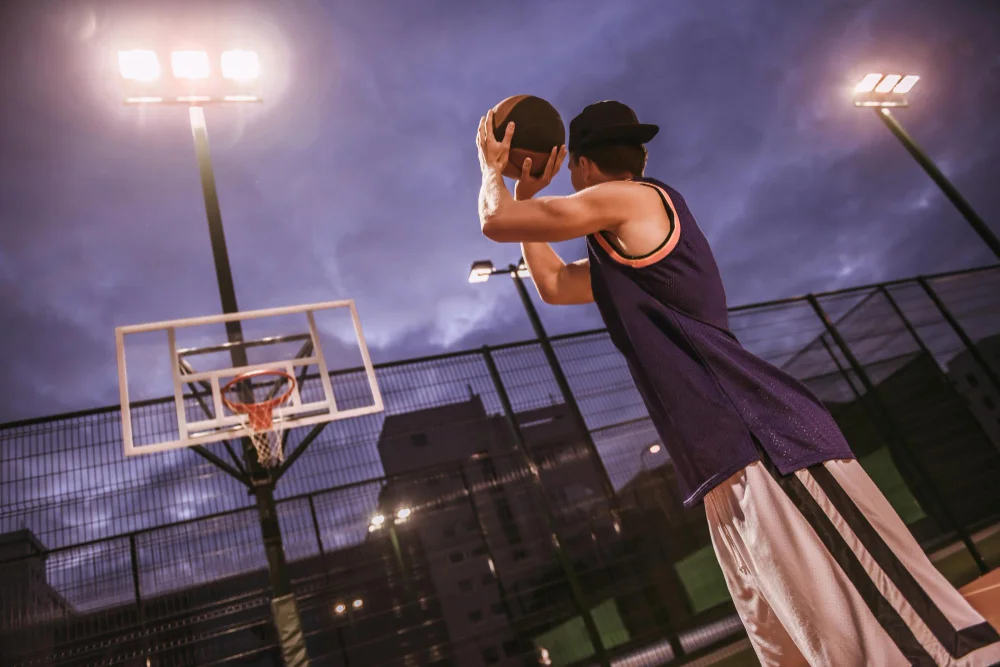
Players regularly look upward during shots, rebounds and high passes, while spectators and where applicable broadcast cameras view the court from different angles.
Court illuminance, vertical visibility, uniformity, glare, fixture position, ceiling or pole geometry, reflections and final aiming therefore all influence the completed system.
PLAN — PROJECT ASSESSMENT
DESIGN — LIGHTING PLANNING
SOURCE — PRODUCT PROCUREMENT
DELIVER — INSTALLATION & HANDOVER
Basketball Lighting Designed Around the Level of Play
Basketball facilities can serve very different purposes.
Basketball lighting projects may include recreational courts, community facilities, schools, training centres, club competitions, professional arenas, televised competitions, and multipurpose sports halls. The lighting criteria for a recreational outdoor court should not automatically be applied to an elite indoor arena, as the visual and operational requirements can differ significantly. The intended level of play, facility type, and any applicable competition or broadcast requirements should therefore be established before final lighting targets are set.


Court Assessment
Lighting planning may consider:
- Court dimensions
- Basket positions
- Backboards
- Free-throw areas
- Three-point zones
- Sidelines
- Spectator seating
- Ceiling height
- Roof structure
- Existing fixtures
- Poles for outdoor courts
- Scoreboards
- Camera locations
- Surrounding properties
- Electrical infrastructure.
For retrofit projects, the existing lighting layout and current problem areas should also be reviewed.
Horizontal Court Illuminance
Horizontal illuminance describes the amount of light reaching the court surface.
It supports visibility of:
- Court markings
- Player movement
- Ball movement
- Officials
- Playing boundaries.
However, horizontal court lighting alone does not fully describe the visual conditions of basketball.
Players and cameras also need useful light on vertical subjects.
Vertical Illuminance
Vertical lighting contributes to visibility of:
- players
- referees
- airborne ball movement
- faces
- uniforms
- broadcast action.
It becomes especially important at higher competition and broadcast levels.
FIBA's current Venue Guide explicitly treats vertical illuminance as a separate performance criterion alongside horizontal illuminance.
Where cameras are involved, vertical lighting should be evaluated relative to the expected camera positions rather than relying only on floor-level calculations.
Court Uniformity
A high average illuminance value can still produce poor basketball visibility if the court contains strong bright-dark variation.
Uniformity therefore matters across the full playing area.
Poor uniformity may result in:
- visibly dark corners
- uneven key areas
- changing ball visibility
- inconsistent broadcast images.
The required uniformity should follow the applicable project or competition criteria.
Why Basketball Lighting Is Particularly Sensitive to Glare
Basketball players frequently look upward.
Common examples include:
- jump shots
- free throws
- rebounds
- alley-oops
- defensive contests
- high passes.
Fixtures positioned poorly above or near the baskets can enter normal player sightlines.
This makes glare control one of the most important basketball-specific lighting issues.
Shooting Sightlines
FIBA's lighting guidance specifically warns against luminaire positions that interfere with a player's vision while shooting.
Fixture locations near basket directions therefore require particular care.
Lighting should be reviewed from:
- free-throw positions
- perimeter shooting zones
- under the basket
- approach directions.
The design objective is to maintain court performance without placing bright sources directly in critical shooting sightlines.
Basket and Backboard Areas
The areas around the baskets are visually important because they contain:
- rebounds
- close shots
- blocks
- referee activity
- backboards
- rims
- nets.
Lighting should maintain useful visibility without creating excessive brightness or glare behind the basket.
Backboard transparency and reflections may also influence how luminaires appear from player and spectator positions.
Rebound Visibility
Players tracking a rebound can rapidly shift their view from the court toward the basket and ceiling.
Lighting should therefore support ball visibility through this changing line of sight.
Strong direct glare around the basket area can make this more difficult.
Ball Tracking
Basketball includes fast movement both horizontally and vertically.
The ball may travel through:
- long passes
- jump shots
- rebounds
- lobs.
Lighting should support visibility throughout these paths.
A design focused only on court-floor illuminance can miss part of this visual requirement.
Indoor Basketball Court Lighting
Indoor courts usually require coordination with:
- ceiling height
- roof trusses
- HVAC
- acoustic systems
- scoreboards
- basketball structures
- spectator seating.
Fixture positioning needs to provide coverage while controlling direct glare and unwanted reflections.
Ceiling geometry can substantially limit the available luminaire positions.
Ceiling-Mounted Lighting
Many indoor basketball courts use ceiling- or roof-mounted luminaires.
The design should consider:
- mounting height
- fixture spacing
- beam distribution
- roof obstructions
- player viewing angles
- maintenance access.
FIBA guidance recommends careful positioning and aiming of luminaires to keep them away from important player and camera glare zones.
Roof and Structural Coordination
Sports halls may contain:
- steel trusses
- suspended scoreboards
- HVAC ducts
- speakers
- acoustic panels
- basketball supports.
Lighting should be coordinated with these systems.
A photometrically suitable fixture location may not be physically possible if structural and MEP constraints are ignored.
Outdoor Basketball Court Lighting
Outdoor courts introduce different design conditions.
Lighting may require:
- dedicated poles
- foundations
- underground cabling
- outdoor-rated equipment
- spill control
- neighbouring-property consideration
- wind and structural review.
The same luminaire arrangement used indoors should not automatically be copied outdoors.
Outdoor Pole Positioning
FIBA's outdoor-court guidance recommends locating lights at the sides of the court and aiming them toward the playing area while keeping luminaires sufficiently elevated to reduce player glare.
Pole positions should also avoid interfering with:
- player runoff
- spectators
- fencing
- access routes.
The actual arrangement depends on site geometry.
Outdoor Light Spill
Outdoor basketball courts can be close to:
- residential properties
- schools
- roads
- parks
- other sports facilities.
Uncontrolled floodlighting may cause unwanted spill beyond the court.
FIBA's outdoor guidance specifically advises avoiding spill that can disturb nearby residents or wildlife.
Fixture optics, shielding, pole location and aiming should therefore be considered together.
Any numerical spill limits should come from the applicable Durham authority or project requirement.
Multiple Adjacent Courts
Sports facilities may contain two or more courts side by side.
This can introduce:
- overlapping beams
- additional glare
- uneven edge conditions
- different control zones.
Each court should remain adequately illuminated without unnecessary cross-light from adjacent courts.
Where appropriate, courts can be designed as separately controllable zones.
Multipurpose Sports Halls
A basketball court may be part of a hall used for:
- badminton
- volleyball
- handball
- events
- school activities.
Lighting design should therefore consider the complete venue brief.
A system designed only around one sport may not satisfy another activity's requirements.
Where several sports are intended, the applicable criteria should be resolved during planning.
DIALux and Photometric Design
Where applicable, VS Wilson can use DIALux and photometric calculations to evaluate basketball-court lighting.
Depending on project requirements, calculations may consider:
- horizontal illuminance
- vertical calculation surfaces
- court uniformity
- fixture distribution
- basket areas
- glare
- ceiling or pole positions
- outdoor spill.
The model should use actual court geometry, mounting heights and selected luminaire photometric files.
Sample DIALux Report
A client-provided DIALux PDF will be published in the service-page evidence tab.
VIEW SAMPLE DIALux REPORT
This representative report demonstrates VS Wilson's photometric-design process. The sample relates to the project type identified in the report. Every project requires a separate design based on its venue, operating conditions and intended use.
The report must retain its genuine project type and must not be presented as completed Basketball Court Lighting evidence unless it genuinely relates to that project.
What Lux Level Does a Basketball Court Need?
There is no single universal basketball-court lux level.
Required lighting depends on:
- recreational or competition use
- indoor or outdoor environment
- competition level
- spectator requirements
- broadcast requirements
- applicable federation or project criteria.
FIBA's current guidance itself gives materially different recommendations for community participation, non-broadcast competition and major competition venues.
The correct project value should therefore be selected from the applicable criteria rather than publishing one blanket Durham figure.
FIBA Basketball Lighting Requirements
FIBA's Venue Guide treats sports lighting as an important part of basketball venue design and identifies several separate performance criteria, including:
- horizontal illuminance
- vertical illuminance
- uniformity
- flicker
- colour rendering
- colour temperature
- glare.
FIBA also warns that lighting is difficult and costly to augment later, so the permanent design should consider the highest competition level the venue realistically intends to host.
VS Wilson should only claim FIBA compliance when the applicable project has actually been designed, tested and accepted against the relevant requirements.
Why Fixture Position Matters Around the Basket
FIBA's current equipment guidance defines specific lighting-position considerations around the basket.
It recommends avoiding fixture locations and aiming directions that may create glare when players shoot.
This means basketball-lighting layout should not be based purely on a symmetrical ceiling grid.
The basket, player approach and shooting directions should influence the luminaire layout.
Broadcast Basketball Lighting
Televised basketball can require more demanding lighting performance.
Relevant criteria may include:
- horizontal illuminance
- vertical illuminance
- camera-facing uniformity
- colour rendering
- colour temperature
- flicker
- player modelling
- spectator/background appearance.
An arena should only be described as broadcast-ready after the applicable production criteria have been verified.
Camera Positions
Broadcast basketball may use:
- main sideline cameras
- baseline cameras
- elevated cameras
- handheld cameras
- overhead or remote cameras.
Different cameras observe players from different directions.
Vertical illumination should therefore be evaluated against the planned camera geometry where applicable.
Flicker and Slow-Motion Replay
Modern basketball broadcasts use high-frame-rate replay.
LED fixtures can appear visually steady while still showing modulation on high-speed cameras.
FIBA includes flicker factor among its lighting-performance considerations.
Where broadcast recording is required, fixture and driver flicker performance should therefore be checked against the actual production requirement.
Colour Rendering
Colour quality can affect the appearance of:
- players
- team uniforms
- court graphics
- ball
- sponsor branding
- skin tones.
The required colour-rendering specification depends on the project and competition level.
No universal CRI value should be assigned to every basketball facility.
Colour Temperature
Colour temperature influences the visual appearance of the court and broadcast picture.
Higher-level competition requirements may define acceptable ranges.
Training and recreational facilities should not automatically inherit elite broadcast specifications.
Reflections From Court Surfaces
Basketball floors can have reflective finishes.
Poorly positioned luminaires can produce:
- visible bright reflections
- visual distraction
- broadcast highlights.
Floor material and reflectance should therefore be considered during design.
Indoor glare assessment should not be based solely on direct view of the fixture.
Player Shadows
Lighting from too few directions can create strong moving shadows.
Balanced fixture distribution can help reduce dominant shadows while maintaining visibility.
The objective is not a universal shadow-free guarantee.
Training Lighting
Training facilities may prioritise:
- player visibility
- ball tracking
- glare control
- court uniformity
- coach observation.
Full broadcast requirements may not be necessary.
Where compatible controls are included, training and competition can use different operating modes.
Competition Lighting
Competition venues may require higher or more controlled performance because of:
- officials
- spectators
- league regulations
- broadcast production.
The exact target should be confirmed from the relevant competition requirements.
Lighting Controls
Where compatible fixtures and controls are specified, basketball lighting may support:
- switching
- dimming
- training mode
- competition mode
- event mode
- maintenance mode.
The actual control architecture should follow the project.
VS Wilson should not claim universal compatibility with any proprietary system unless verified.
Emergency Lighting Is Separate
Basketball sports lighting and emergency lighting have different functions.
The venue may require separate emergency systems for:
- exits
- spectator stairs
- aisles
- corridors
- escape routes.
Normal court-lighting controls should not be presented as a replacement for required emergency lighting.
Durham Outdoor Conditions
Outdoor basketball lighting equipment in Durham may be exposed to:
- high ambient temperatures
- direct solar exposure
- dust
- humidity
- coastal saline conditions in some locations
- wind.
Fixture, driver, pole and coating suitability should be checked from manufacturer documentation and actual project conditions.
VS Wilson does not apply one universal IP rating, lifetime or warranty to every outdoor basketball fixture.
New Basketball Court Projects
Early lighting planning can coordinate:
- court orientation
- ceiling or pole positions
- electrical routes
- scoreboard
- seating
- roof structure
- MEP services
- cameras
- controls.
This reduces the need for late fixture relocation or electrical changes.
Existing Court Retrofit
Existing courts can also be assessed for lighting upgrades.
Retrofit review may include:
- existing fixtures
- ceiling or pole positions
- mounting height
- glare complaints
- dark zones
- electrical capacity
- controls
- competition requirements.
A retrofit should be recalculated around the current court rather than replacing fixtures only by wattage.
LED Basketball Court Retrofit
An LED upgrade should still be checked for:
- court illuminance
- uniformity
- glare
- basket sightlines
- vertical visibility
- flicker where applicable
- controls.
No fixed energy-saving percentage should be guaranteed.
Existing Pole or Mounting Reuse
Existing poles or indoor mounting positions may be reusable where appropriate.
Review may need to consider:
- structural condition
- mounting height
- fixture weight
- aiming range
- photometric suitability.
Existing infrastructure should not automatically dictate the new lighting layout if it prevents the required performance.
Multi-Brand Fixture Sourcing
VS Wilson can source basketball-court lighting products according to project specification, client preference, documentation and market availability.
Products may include:
- indoor sports luminaires
- outdoor sports floodlights
- drivers
- brackets
- poles where applicable
- control components
- associated electrical materials.
Selection may consider:
- photometric distribution
- glare control
- colour quality
- flicker performance
- thermal suitability
- environmental exposure
- control compatibility.
Actual lifetime, IP rating, warranty and performance remain manufacturer-specific.
Electrical Installation
VS Wilson can undertake electrical installation according to the agreed basketball-lighting scope.
Work may include:
- lighting circuits
- cabling
- fixture installation
- pole connections
- compatible controls
- fixture aiming.
Execution should follow the approved photometric design and real site conditions.
Final Aiming
Basketball lighting is highly sensitive to fixture direction.
Incorrect aiming can produce:
- basket glare
- dark court areas
- uneven vertical visibility
- excessive outdoor spill
- poor camera performance.
Final fixture alignment should therefore follow the approved design and be checked on site.
Testing and Photometric Verification
Commissioning may include:
- fixture operation
- electrical circuits
- control modes
- fixture alignment
- representative court measurements
- visible glare.
Where competition or broadcast verification is required, the measurement grid and acceptance criteria should follow the applicable federation or project standard.
A few random lux readings should not be described as full compliance testing.
Common Basketball Lighting Problems We Assess
Average Lux Is High but the Court Is Uneven
The system achieves brightness without adequate uniformity.
Players See Lights During Jump Shots
Fixtures are positioned inside common upward shooting sightlines.
Basket Areas Create Glare
Luminaire positions or aiming conflict with shooting directions.
Court Floor Shows Strong Reflections
Fixture geometry and floor finish have not been considered together.
The Ball Becomes Harder to See in the Air
Lighting has focused mainly on the horizontal playing surface.
Cameras Show Players Unevenly
Vertical illumination has not been considered sufficiently.
Slow-Motion Video Shows Flicker
Fixture or driver performance does not match the production requirement.
Indoor Fixtures Conflict With Roof Services
Lighting is designed without coordinating structure, HVAC or scoreboards.
Outdoor Light Reaches Nearby Homes
Pole placement, optics or aiming produce excessive spill.
Adjacent Courts Interfere With Each Other
Cross-light and control zoning have not been planned.
Retrofit Repeats the Existing Layout Problem
New luminaires are installed in old positions without recalculating the system.
No Final Court Verification
Fixtures operate electrically but aiming, glare and actual court distribution have not been checked.
What Determines Basketball Court Lighting Cost in Durham?
Basketball-lighting cost depends on the venue and required performance.
Relevant factors may include:
- number of courts
- indoor or outdoor installation
- ceiling or pole height
- level of play
- broadcast requirements
- fixture quantity
- luminaire specification
- poles and foundations
- electrical infrastructure
- controls
- existing mounting reuse
- retrofit conditions
- DIALux/design scope
- testing and commissioning.
A project-specific quotation should follow review of the actual court and required criteria.
Information Helpful for a Basketball Lighting Proposal
Where available, provide:
- Durham project location
- number of courts
- indoor or outdoor condition
- court dimensions
- level of play
- competition requirements
- reflected ceiling or roof plans
- ceiling height
- basket/backboard locations
- seating layout
- existing or proposed pole positions
- electrical drawings
- camera positions where relevant
- broadcast requirements
- control requirements
- existing lighting information for retrofit
- project programme.
VS Wilson Basketball Court Lighting Project Process
1. SITE ASSESSMENT
Review court geometry, level of play and existing project conditions.
2. DRAWING REVIEW
Review court, basket, ceiling/pole, electrical and applicable camera information.
3. LIGHTING PLANNING
Define performance criteria, fixture positions and operating requirements.
4. PHOTOMETRIC DESIGN
Carry out DIALux or applicable basketball-court lighting calculations.
5. PRODUCT SOURCING
Source suitable indoor or outdoor basketball-lighting products.
6. ELECTRICAL INSTALLATION
Execute approved lighting and related electrical works.
7. SYSTEM TESTING
Test fixtures, circuits and applicable controls.
8. FINAL COMMISSIONING
Complete aiming, applicable court verification and handover.
Why Basketball Lighting Design and Installation Need to Stay Connected
Basketball-lighting calculations depend on actual:
- fixture locations
- mounting heights
- basket positions
- beam distributions
- aiming
- camera locations
- court geometry.
If these conditions change during installation, the real performance can differ from the photometric design.
VS Wilson can coordinate planning, sourcing, electrical installation, testing and commissioning within one agreed project scope.
Basketball Court Lighting Across Durham
VS Wilson provides basketball court lighting project support in Durham through project-specific planning, mobilisation and on-site execution, subject to the agreed scope. Service availability does not imply a permanent local office.
Projects elsewhere in Durham are handled through project mobilisation and service delivery according to the agreed scope.
This Durham-wide service coverage does not imply a permanent VS Wilson office in every service area.
Project Evidence
Only verified first-party evidence should be presented here.
Sample DIALux Report
A client-provided DIALux PDF can demonstrate VS Wilson's photometric-design process.
VIEW SAMPLE DIALux REPORT
The report must retain its genuine project type and must not be presented as completed Basketball Court Lighting evidence unless it genuinely relates to that project.
Verified Project Photographs and References
Court names, venue names, photographs, client identities, locations and references should be added only after verification and approval for publication.
Until then, representative basketball imagery must not be labelled as completed VS Wilson project work.
Frequently Asked Questions
What is basketball court lighting?
Basketball court lighting is the planned illumination of the playing court to support player, referee, spectator and—where applicable—broadcast visibility.
Does VS Wilson provide basketball court lighting across Durham?
Yes. VS Wilson provides lighting consultation, design, multi-brand sourcing, electrical installation, testing and commissioning across Durham according to the agreed project scope.
What lux level does a basketball court need?
There is no single universal lux value. The required lighting depends on recreational, training, competition or broadcast use and the applicable project criteria.
Why is glare especially important in basketball?
Players frequently look upward during shots, rebounds and high passes, so poorly placed luminaires can enter normal playing sightlines.
Why is vertical illumination important?
Vertical lighting helps players, officials and the airborne ball remain visible from spectator and camera directions.
What is court uniformity?
Court uniformity describes how consistently the playing area is illuminated rather than relying only on the average illuminance value.
Does VS Wilson use DIALux for basketball court lighting?
Yes. DIALux and photometric calculations are available where applicable and where sufficient court and luminaire information is available.
Are indoor and outdoor basketball lighting systems the same?
No. Indoor courts are strongly influenced by ceilings, structural services and reflections, while outdoor courts require poles, outdoor equipment and spill-light control.
How can glare around the basket be reduced?
Fixture positions, mounting height, optics and aiming should be planned around actual shooting sightlines and basket locations.
Can basketball lighting be designed for broadcast?
Yes, where the project provides the applicable broadcast criteria. Broadcast compliance should only be claimed after those requirements have been verified.
Why does flicker matter for basketball broadcasts?
High-speed and slow-motion cameras can reveal light-output modulation that may not be visible to spectators.
Can an existing basketball court be upgraded to LED?
Yes. Existing courts can be assessed for retrofit, but the layout should be recalculated rather than relying only on wattage replacement.
Can outdoor basketball lighting disturb nearby properties?
Yes. Poorly controlled outdoor lighting can create spill and glare, which should be managed through optics, pole position and aiming.
Can multiple courts have separate lighting controls?
Yes, where compatible electrical and control systems are specified.
Does LED basketball lighting guarantee energy savings?
No fixed saving should be guaranteed. Actual consumption depends on the existing system, new connected load, controls and operating hours.
How much does basketball court lighting cost in Durham?
Pricing depends on court count, indoor/outdoor conditions, mounting heights, fixtures, poles, controls, electrical infrastructure, level of play and commissioning requirements.
Discuss Your Basketball Court Lighting Project
Planning an indoor basketball arena, outdoor court, training facility or existing-court upgrade in Durham?
Share your court dimensions, basket positions, ceiling or pole information, competition level and electrical requirements with VS Wilson.
Our team can review the project and establish the appropriate scope for basketball-lighting planning, DIALux or photometric design, fixture sourcing, electrical installation, aiming, testing and commissioning.
To know more about VS Wilson and our expertise, visit our About Us page. For more information, project requirements, or enquiries about our lighting solutions, Contact VS Wilson today.
Image Gallery