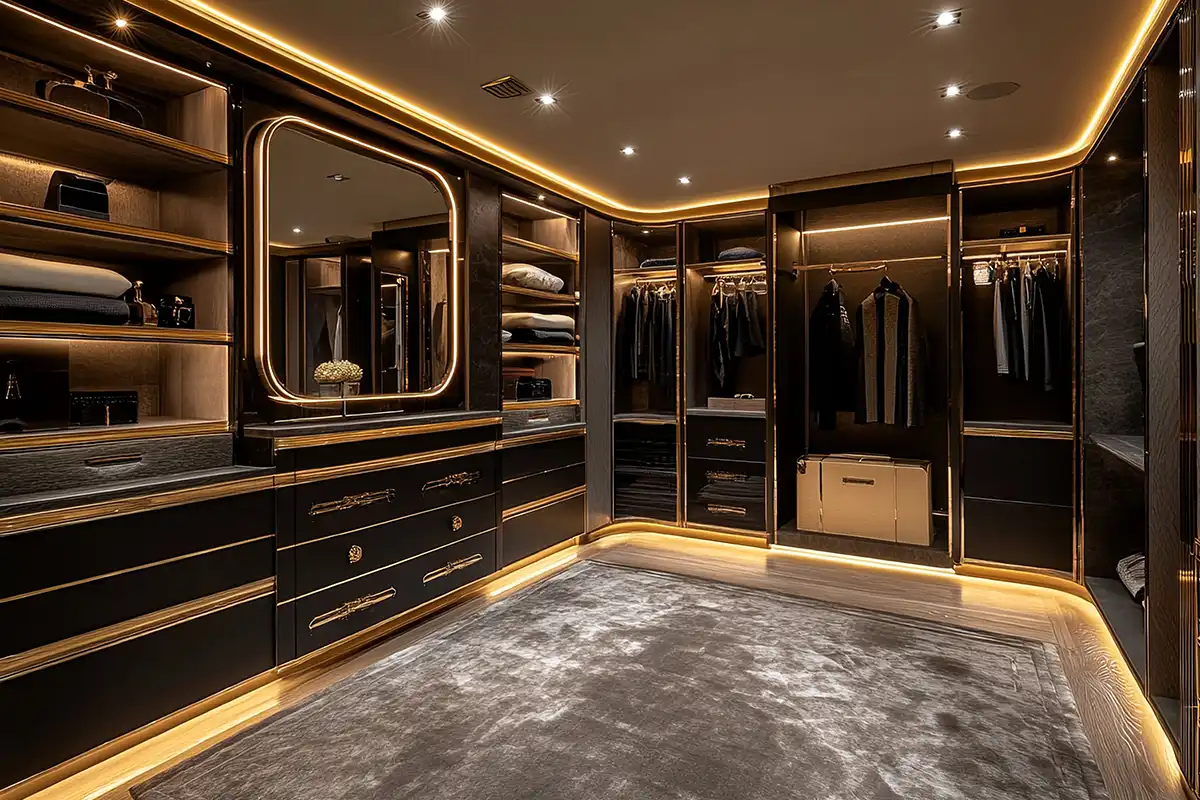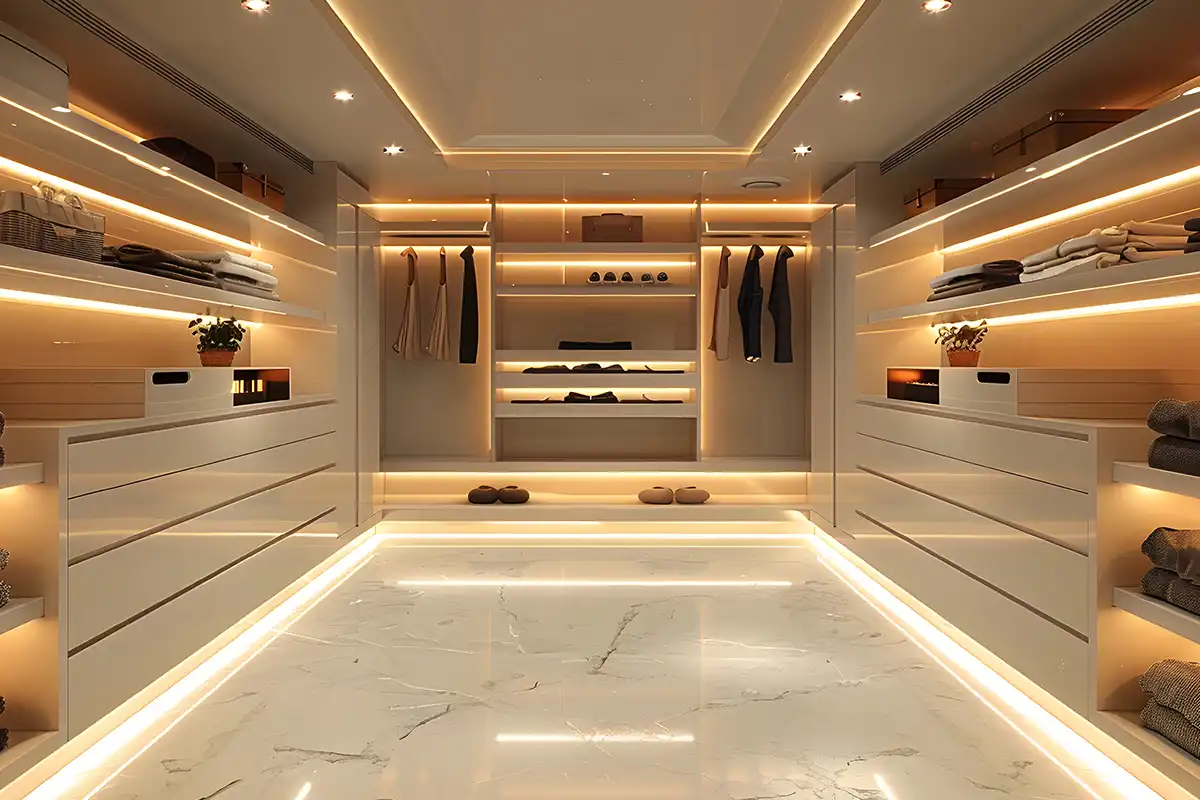
Dressing Room Lighting Design in Antalya
VS Wilson provides dressing room lighting design and installation services across Antalya for villas, apartments, walk-in wardrobes and residential dressing areas. The service combines lighting planning, wardrobe and mirror coordination, DIALux or photometric design (where applicable), fixture sourcing, electrical installation, testing, and final commissioning.
The lighting plan is developed around the actual wardrobe configuration, storage depth, hanging sections, shelving, drawers, mirrors, circulation areas and intended use of the dressing room. This helps avoid common problems such as dark wardrobe interiors, shadows across garments, glare at mirrors and lighting points that conflict with joinery.
VS Wilson operates from Dubai and delivers projects across the Antalya through service delivery and project mobilisation.
What is Dressing Room Lighting Design?
Dressing room lighting design is the planning of lighting for wardrobe storage, dressing areas, mirrors, grooming zones and circulation spaces.
Unlike general bedroom lighting, dressing-room lighting has to illuminate both the room and the vertical surfaces where clothes, accessories and mirrors are located. A single ceiling light may provide general visibility while still leaving hanging clothes, shelves or drawers poorly illuminated.
A coordinated lighting design can combine ambient room lighting, integrated wardrobe lighting, shelf and hanging-section lighting, drawer lighting, mirror and vanity lighting, accent or display lighting, sensor-controlled lighting, dimmable lighting, cove or concealed lighting, and directional spotlights where appropriate. The exact combination should be determined by the room layout, wardrobe construction, finishes, mirror position, electrical arrangement and overall project requirements.


Dressing Room Lighting Design & Installation in Antalya
VS Wilson handles the lighting design and execution as a coordinated workflow rather than treating lighting installation as a separate final-stage activity.
The process can include:
- Reviewing the dressing-room layout
- Reviewing wardrobe and joinery drawings
- Identifying storage and dressing zones
- Planning ambient and task lighting
- Coordinating mirror illumination
- Developing photometric calculations where applicable
- Selecting suitable fixtures and control systems
- Coordinating electrical routing and driver locations
- Procuring approved lighting products
- Installing the lighting system
- Testing the installed system
- Completing final alignment and commissioning
This approach helps reduce conflicts between lighting positions, wardrobes, shelving, doors, mirrors and electrical infrastructure.
Dressing Room Lighting for Walk-In Wardrobes
Walk-in wardrobes require lighting that works across multiple storage surfaces rather than simply illuminating the floor.
Depending on the layout, the design may address:
- Full-height hanging sections
- Double-hanging sections
- Open shelves
- Closed cabinets
- Shoe storage
- Handbag displays
- Accessory drawers
- Dressing islands
- Full-height mirrors
- Vanity areas
- Circulation paths
- Feature or display sections
Wardrobe lighting should be planned before final joinery installation wherever possible because wiring, channels, drivers and sensor positions may need to be integrated into the furniture.
Antalya wardrobe specialists similarly emphasise integrated LED lighting, sensor activation and lighting planned as part of the wardrobe rather than as an afterthought.
Wardrobe Interior Lighting
Wardrobe interiors can contain deep shelves and hanging areas where ceiling light is easily blocked by the user or the furniture itself.
VS Wilson can plan integrated lighting for:
Hanging Sections
Lighting can be positioned to illuminate garments along their visible vertical surfaces while reducing shadows caused by the wardrobe structure.
Shelves
Linear or concealed lighting can be integrated beneath shelves where appropriate to improve visibility of folded clothing, accessories and displayed items.
Drawers
Lighting can be considered for accessory, jewellery or storage drawers where visibility inside the drawer is important.
Shoe Storage
Dedicated lighting can be used to illuminate lower shelving and shoe-display areas.
Glass-Fronted Storage
Lighting can be integrated with display sections to provide controlled illumination without unnecessarily exposing the light source to direct view.
The final fixture position depends on the joinery construction, shelf dimensions, material finishes and available electrical routing.
Mirror & Vanity Lighting
The mirror is one of the most important task areas in a dressing room.
Poorly positioned lighting can create strong facial shadows, reflections or glare, particularly when the primary source is directly above the mirror.
The design can consider:
- Vertical lighting beside the mirror
- Integrated mirror lighting
- Diffused linear fixtures
- Vanity lighting
- Adjustable lighting
- Dimmable controls
- Matching wardrobe and mirror lighting
- Reflection and glare control
The objective is to provide useful illumination across the face and body without relying exclusively on a ceiling fixture directly above the user.
Antalya mirror-lighting suppliers also identify even facial illumination and avoiding shadows and glare as key considerations for dressing and grooming areas.
Layered Lighting for Dressing Rooms
A well-planned dressing room may use multiple lighting layers instead of one source.
Ambient Lighting
Provides general illumination throughout the room and circulation areas.
Possible solutions include:
- Recessed downlights
- Linear ceiling lighting
- Cove lighting
- Surface-mounted fixtures
- Architectural concealed lighting
Task Lighting
Focused on areas where users perform specific activities.
Examples include:
- Wardrobe interiors
- Hanging sections
- Shelves
- Drawers
- Dressing tables
- Vanity mirrors
Accent Lighting
Used where selected wardrobe features, display cabinets, architectural details or accessories need additional emphasis.
The layers can be independently switched or dimmed where the project requires different lighting scenes.
Sensor-Based Wardrobe Lighting
Sensor-controlled lighting can be integrated into wardrobes and storage areas where appropriate.
Possible control methods include:
- Door sensors
- Magnetic contact sensors
- Motion sensors
- Occupancy-based controls
- Manual override
- Dimming controls
- Smart-home integration where compatible
The sensor and driver arrangement should be planned with the wardrobe construction so that components remain accessible for future service where required.
Antalya product examples demonstrate door-activated wardrobe lighting and dimming as practical integrated features.The design and installation must follow the applicable local building, electrical, fire-safety and project-authority requirements.
Dressing Room Lighting & Colour Visibility
Dressing rooms are used to select and compare clothing, accessories and other materials, so the quality of light matters in addition to brightness.
The design should consider:
- Colour rendering
- Colour consistency between fixtures
- Colour temperature
- Glare
- Reflections from mirrors
- Light distribution across garments
- Appearance of fabrics under the selected light source
Rather than applying one universal CRI or colour-temperature value to every project, VS Wilson can specify the appropriate lighting characteristics based on the client’s requirements, fixture availability, finishes and intended use.
This is particularly important where the wardrobe and mirror are positioned close together and users move between the two areas.
Dressing Room Lighting Problems We Solve
Common problems include:
Dark Wardrobe Interiors
General ceiling lighting may not penetrate sufficiently into deep storage.
Design response: integrate dedicated lighting into appropriate storage zones.
Self-Shadowing
The user’s body can block light reaching hanging clothes.
Design response: position fixtures according to the wardrobe geometry and viewing direction.
Mirror Shadows
Lighting directly above a mirror can create unwanted facial shadows.
Design response: coordinate mirror-side or integrated lighting based on the mirror design.
Glare
Exposed LED sources can become uncomfortable when viewed from the dressing position or reflected in mirrors.
Design response: select appropriate optics, diffusion, positioning and shielding.
Lighting Conflicts With Joinery
Lighting points can become blocked by shelves, doors or wardrobe panels.
Design response: review lighting and joinery drawings together before installation.
Driver & Wiring Access
Drivers hidden behind permanently fixed joinery can create future maintenance difficulties.
Design response: coordinate driver positions and access requirements during design.
Inconsistent Colour
Different fixture types or batches can produce visibly different colour appearance.
Design response: coordinate the lighting specification and product selection across the dressing area.
DIALux & Photometric Lighting Design
Where applicable, VS Wilson can use DIALux or other photometric calculations to evaluate the proposed dressing-room lighting arrangement before installation.
The design process can assess:
- Fixture locations
- Light distribution
- Illuminated zones
- Potential shadow areas
- Mirror and vanity lighting
- Wardrobe storage areas
- Circulation zones
- Fixture quantity
- Beam distribution
- Lighting levels based on the project brief
The calculation is developed from project-specific information rather than applying one universal lighting value to every dressing room.
Inputs for the Lighting Calculation
Depending on the project, VS Wilson may require:
- Architectural floor plan
- Dressing-room dimensions
- Ceiling height
- Wardrobe layout
- Joinery drawings
- Shelf positions
- Hanging-section dimensions
- Mirror dimensions and location
- Furniture layout
- Surface and finish information
- Fixture specifications
- Control requirements
- Existing lighting information for retrofit projects
Lighting Fixtures for Dressing Rooms
Depending on the design, VS Wilson can source suitable fixtures such as:
- LED linear profiles
- LED strip lighting
- Recessed linear fixtures
- Recessed spotlights
- Adjustable spotlights
- Wardrobe-integrated lighting
- Shelf lighting
- Drawer lighting
- Mirror lighting
- Vanity fixtures
- Cove lighting
- Display lighting
- Sensor-controlled fixtures
Fixture selection depends on the installation location, optical requirements, joinery details, electrical system, product availability and project specification.
VS Wilson supports multi-brand product and fixture sourcing according to specification, client preference, documentation and market availability.
Electrical & Joinery Coordination
Dressing-room lighting should be coordinated with the furniture package before installation.
The coordination may cover:
- Lighting channels
- Cable routes
- Driver locations
- Power supplies
- Switch locations
- Sensor positions
- Wardrobe doors
- Sliding doors
- Shelves
- Drawers
- Mirror locations
- Access panels
- Ceiling fixtures
This reduces the risk of installing a lighting point where a shelf, panel or wardrobe door later blocks the intended light distribution.
New Dressing Room Lighting Projects
For new villas, apartments and residential developments, lighting can be incorporated during the design and construction stages.
VS Wilson can coordinate with:
- Architects
- Interior designers
- MEP consultants
- Electrical contractors
- Joinery contractors
- Main contractors
- Property owners
- Facility representatives
Early coordination allows lighting positions and electrical provisions to be incorporated into the wardrobe and interior design before construction is completed.
Dressing Room Lighting Retrofit
VS Wilson can also assess existing dressing rooms and wardrobes where lighting needs to be upgraded.
Retrofit work may include:
- Replacing unsuitable fixtures
- Adding wardrobe-integrated lighting
- Improving mirror illumination
- Adding sensors
- Revising switching arrangements
- Improving light distribution
- Re-routing wiring where practical
- Upgrading older lighting systems
- Adding dimming or control options where compatible
The retrofit approach depends on the existing electrical installation, wardrobe construction, access conditions and selected products.
Antalya-Specific Dressing Room Considerations
Dressing rooms in Antalya residences can range from compact apartment wardrobes to large villa dressing suites.
The design therefore needs to respond to the actual project rather than use one standard layout.
Important considerations can include:
- Compact versus large wardrobe layouts
- Deep storage cabinets
- Full-height wardrobes
- High-end joinery finishes
- Mirrors and reflective surfaces
- Integrated lighting channels
- Concealed wiring
- Driver accessibility
- Heat management within enclosed joinery
- Dust and cleaning considerations
- Smart-home integration
- MEP coordination
- Client preferences for lighting scenes
The design and installation must follow the applicable local building, electrical, fire-safety and project-authority requirements.
Product Sourcing for Dressing Room Lighting
VS Wilson can handle product sourcing according to the approved lighting design and project specification.
The sourcing stage can consider:
- Fixture dimensions
- Output
- Beam distribution
- Colour characteristics
- Dimming compatibility
- Sensor compatibility
- Driver requirements
- Installation method
- Joinery integration
- Product documentation
- Availability
- Client preference
- Project budget
The selected products should be compatible with the proposed electrical and control system before procurement.
Installation & On-Site Execution
VS Wilson’s installation scope can include:
- Electrical preparation
- Cable routing
- Fixture installation
- Linear profile installation
- Wardrobe lighting installation
- Mirror lighting installation
- Sensor installation
- Driver installation
- Control connection
- Fixture alignment
- Functional testing
Installation is coordinated with the final wardrobe and interior configuration to ensure that the installed system matches the approved lighting plan.
Testing, Adjustment & Commissioning
After installation, the lighting system can be tested under actual project conditions.
Testing may cover:
- Fixture operation
- Switching
- Dimming
- Sensor response
- Driver operation
- Lighting distribution
- Mirror illumination
- Wardrobe illumination
- Control functionality
- Fixture alignment
Where required, final adjustments can be completed after the wardrobe, mirrors and interior finishes are fully installed.
The purpose of commissioning is to ensure that the lighting system functions according to the agreed design and project requirements.
What Affects Dressing Room Lighting Cost?
There is no single fixed price for dressing-room lighting because project scope varies considerably.
Key cost factors include:
- Dressing-room size
- Number of wardrobe sections
- Number of lighting zones
- Fixture type
- Linear lighting length
- Number of shelves and drawers
- Mirror size
- Sensor requirements
- Dimming/control requirements
- Driver quantity
- Wiring complexity
- Joinery integration
- Ceiling access
- Retrofit requirements
- Installation conditions
- Product specification
- Testing and commissioning scope
A project quotation should therefore be based on the actual drawings, lighting requirements and installation conditions.
Dressing Room Lighting Design Process
1. Project Consultation
Discuss the room, wardrobe configuration, intended use and lighting requirements.
2. Drawing & Layout Review
Review architectural, electrical and joinery drawings where available.
3. Lighting Planning
Define ambient, wardrobe, mirror, task and accent lighting zones.
4. Photometric Design
Prepare DIALux or appropriate calculations where applicable.
5. Fixture Selection
Select suitable fixtures, controls, drivers and accessories.
6. Product Sourcing
Source approved products according to the project specification.
7. Electrical Coordination
Coordinate wiring, power supplies, drivers, switches and sensors.
8. Installation
Install and align the lighting system on site.
9. Testing
Test fixtures, controls, sensors and lighting operation.
10. Commissioning
Complete final adjustments and handover according to the agreed project scope.
What We Need to Prepare a Dressing Room Lighting Proposal
To assess a project, clients can provide:
- Project location in Antalya
- Floor plan
- Dressing-room dimensions
- Ceiling height
- Wardrobe layout
- Joinery drawings
- Mirror dimensions
- Interior photographs for existing spaces
- Existing lighting details for retrofit projects
- Preferred lighting style
- Fixture preferences, if any
- Smart-control requirements
- Project timeline
- Installation requirements
For a new project, architectural and joinery drawings are particularly useful because lighting positions can be coordinated before fabrication and installation.
Sample DIALux Evidence
VIEW SAMPLE DIALux REPORT
The client-provided DIALux PDF will be published in the service-page evidence tab.
The report should remain identifiable as the actual project/document type and should not be renamed or presented as evidence of a different project. Any confidential information should be redacted before publication.
If the representative report relates to another project type, display the required disclosure:
This representative report demonstrates VS Wilson’s photometric-design process. The sample relates to the project type identified in the report. Every project requires a separate design based on its venue, operating conditions and intended use.
The evidence area should also include a short HTML explanation of what the report demonstrates and a direct working link to the PDF.
VS Wilson Dressing Room Lighting Capability
SITE ASSESSMENT
DRAWING REVIEW
LIGHTING PLANNING
PHOTOMETRIC DESIGN
PRODUCT SOURCING
ELECTRICAL INSTALLATION
SYSTEM TESTING
FINAL COMMISSIONING
Why Use an End-to-End Dressing Room Lighting Service?
Dressing-room lighting involves more than selecting decorative fixtures.
Wardrobes, mirrors, shelves, drawers, ceiling lighting, sensors and electrical infrastructure all need to work together.
An end-to-end workflow can reduce coordination gaps between:
- Lighting design
- Joinery
- Electrical works
- Fixture procurement
- Installation
- Controls
- Testing
- Final commissioning
VS Wilson provides consultation, lighting design, DIALux/photometric calculations where applicable, product sourcing, electrical installation, testing and commissioning, with both new-project and retrofit scope available.
FAQs
What is dressing room lighting design?
Dressing room lighting design is the planning of ambient, wardrobe, mirror, task and accent lighting for dressing spaces. It considers wardrobe layout, storage depth, mirrors, user position, electrical routing and the intended use of the room.
Do you provide dressing room lighting installation in Antalya?
Yes. VS Wilson provides lighting installation as part of its project delivery scope across Antalya, subject to the agreed project proposal.
Can you design lighting for walk-in wardrobes?
Yes. Lighting can be planned for walk-in wardrobes, including hanging sections, shelves, drawers, shoe storage, mirrors, dressing islands and circulation areas.
Can wardrobe lights be connected to sensors?
Yes. Sensor-based lighting can be incorporated where appropriate, including door-activated or other control arrangements depending on the wardrobe and electrical design.
How do you prevent shadows around a dressing mirror?
Mirror lighting should be designed around the user’s position and mirror geometry. Depending on the project, vertical or integrated lighting can provide more useful face illumination than relying only on an overhead fixture.
Can you coordinate lighting with wardrobe joinery?
Yes. Lighting positions, channels, wiring, drivers and sensors can be coordinated with wardrobe and joinery drawings to reduce conflicts during installation.
Do you use DIALux for dressing room lighting design?
DIALux or other photometric calculations can be used where applicable to evaluate fixture positions, distribution and project-specific lighting requirements.
Can you upgrade lighting in an existing dressing room?
Yes. Retrofit projects can include fixture upgrades, wardrobe lighting, mirror lighting, sensors, controls and electrical modifications where practical.
How much does dressing room lighting cost in Antalya?
Cost depends on the dressing-room size, wardrobe configuration, number of lighting zones, fixture specification, controls, wiring, joinery coordination and installation requirements. A project-specific quotation is required for accurate pricing.
Do you supply the lighting fixtures?
Yes. VS Wilson provides product and fixture sourcing according to the project specification, client preference, documentation and market availability.
Do you provide testing and commissioning?
Yes. Testing and final commissioning are part of VS Wilson’s available project-delivery capabilities, subject to the agreed scope.
Discuss Your Dressing Room Lighting Project
Planning a new villa dressing room, upgrading an existing wardrobe or integrating lighting into custom joinery?
Share your drawings, wardrobe layout, photographs or project requirements with VS Wilson for a project-specific lighting assessment and proposal.
To know more about VS Wilson and our expertise, visit our About Us page. For more information, project requirements, or enquiries about our lighting solutions, Contact VS Wilson today.
Image Gallery